
AI Agents are rapidly evolving from simple conversational assistants into autonomous systems capable of executing complex workflows. They can access Git repositories, interact with cloud infrastructures, query enterprise databases, trigger CI/CD pipelines, communicate with internal applications, and even make business decisions.
This new level of autonomy introduces a challenge that many organizations underestimate: credential security.
While most discussions focus on prompt engineering, hallucinations, or Retrieval-Augmented Generation (RAG), one of the biggest risks lies elsewhere.
Who controls the credentials that empower AI Agents?
Every API key, OAuth token, service account, SSH key, database password, or cloud identity assigned to an AI Agent represents potential attack surface.
A compromised AI Agent isn’t merely an intelligent chatbot.
It can become an autonomous insider with legitimate access to critical systems.
This article explores:
- Why credential management is the hidden security risk of AI Agents
- The evolving threat landscape
- Common security mistakes
- Production-ready architectures
- Best practices inspired by Zero Trust
- Practical recommendations for engineering teams
AI Agents Are Different
Traditional software follows predefined execution paths.
AI Agents don’t.
Instead, they:
- Reason
- Plan
- Choose tools
- Invoke APIs
- Maintain memory
- Execute multiple actions
- Adapt dynamically
That flexibility makes them extremely powerful.
It also makes identity management dramatically more complex.
Traditional applications generally have predictable authentication flows.
AI Agents continuously decide:
- Which tool should I use?
- Which credential should authenticate this request?
- Should I call another service?
- Should I access a database?
- Should I execute code?
Every decision potentially involves credentials.
Why Credentials Matter
Without credentials, an AI Agent is simply an LLM capable of generating text.
Credentials transform it into an operational system.
They allow access to:
- GitHub
- GitLab
- Jira
- Confluence
- AWS
- Azure
- Google Cloud
- Kubernetes
- Databases
- Slack
- Microsoft Teams
- Salesforce
- SAP
- Internal APIs
- MCP Servers
- Payment gateways
- CI/CD pipelines
In other words…
Credentials define the real power of an AI Agent.
The AI Agent Identity Problem
Many organizations unknowingly build agents like this:
AI Agent
     │
     │
     ├── GitHub Admin Token
     ├── AWS Administrator
     ├── Database Root Account
     ├── Kubernetes Cluster Admin
     ├── Slack Workspace Admin
     └── Internal API Master Key
Everything works.
Until something goes wrong.
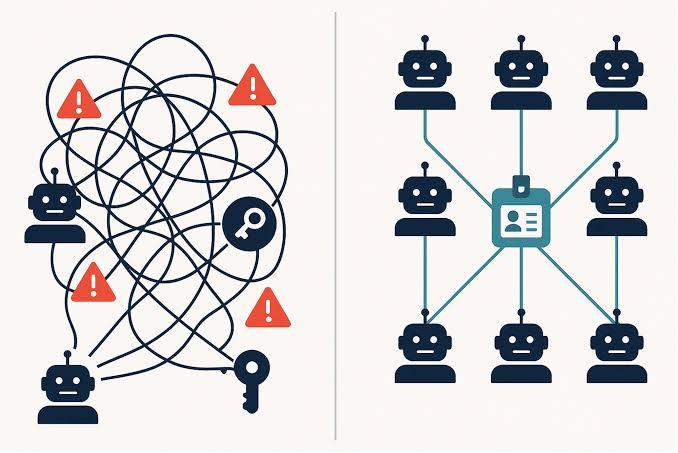
If the agent is compromised:
- Every connected system is compromised.
The Hidden Attack Surface
An AI Agent may simultaneously possess:
- Multiple API keys
- OAuth refresh tokens
- Service accounts
- JWT tokens
- SSH private keys
- Cloud identities
- Temporary credentials
- Enterprise cookies
- MCP authentication tokens
This creates an enormous attack surface.
Unlike humans,
AI Agents never sleep.
They execute requests continuously.
Understanding AI Agent Credentials
| Credential Type | Purpose | Risk Level |
|---|---|---|
| API Keys | Service authentication | High |
| OAuth Tokens | Delegated user access | High |
| Service Accounts | Machine identities | Critical |
| SSH Keys | Infrastructure access | Critical |
| JWT Tokens | Session authentication | Medium |
| Database Credentials | Data access | Critical |
| Cloud IAM Roles | Cloud resources | Critical |
| Kubernetes Tokens | Cluster access | Critical |
| MCP Tokens | Tool communication | High |
Notice something?
Almost every credential provides access to valuable assets.
Why AI Agents Need Their Own Identity
One of the biggest architectural mistakes is sharing human credentials.
Example:
❌ Bad
Developer OAuth Token

       ↓

Developer
      │
      └── AI Agent
If the developer leaves the company…
The AI Agent still has access.
If the developer becomes an administrator…
The AI Agent automatically inherits those permissions.
This violates one of the oldest principles in cybersecurity.
Instead:
Developer

Creates

Dedicated AI Identity

↓

AI Agent

↓

Limited Permissions
Each AI Agent should have:
- Its own identity
- Its own permissions
- Its own audit logs
- Its own lifecycle
Never reuse employee credentials.
The Principle of Least Privilege
One of the most effective security controls remains the simplest:
Grant only the permissions strictly required.
Unfortunately, many organizations do the opposite.
Instead of asking:
What does the agent need?
they ask:
What is the easiest credential to configure?
That usually ends with Administrator privileges.
Imagine an AI Agent that summarizes Jira tickets.
It probably needs:
✅ Read Issues
It does NOT need:
❌ Delete Projects
❌ Manage Users
❌ Modify Permissions
❌ Create Repositories
Small permissions dramatically reduce the impact of a compromise.
The Lifecycle of an AI Credential
Credential management is not only about creation.
It is a complete lifecycle.
Create

↓

Store Securely

↓

Distribute

↓

Use

↓

Rotate

↓

Monitor

↓

Revoke

↓

Destroy
Skipping only one phase creates unnecessary risk.
Where Should Secrets Be Stored?
One of the worst practices is embedding credentials directly into code.
Example:
OPENAI_API_KEY="sk-xxxxxxxxxxxxxxxx"
DATABASE_PASSWORD="admin123"
AWS_SECRET="xxxxxxxx"
Even private repositories eventually leak.
Instead, secrets should be retrieved dynamically from dedicated secret management solutions.
Examples include:
- HashiCorp Vault
- AWS Secrets Manager
- Azure Key Vault
- Google Secret Manager
- Kubernetes Secrets (combined with encryption and RBAC)
- External Secrets Operator
The AI Agent should never “know” the secret beforehand, it should request it securely when needed and only for the duration required.
The Danger of Long-Lived Credentials
Long-lived API keys are convenient.
They are also dangerous.
If leaked, they may remain valid for months or even years.
A more secure approach is to use:
- Short-lived OAuth tokens
- Temporary cloud credentials
- Federated identities
- Workload identities
- Automatic credential rotation
The shorter the credential lifetime, the smaller the attack window.
Real-World Attack Scenario
Imagine a customer support AI Agent connected to:
- CRM
- Billing system
- Internal knowledge base
- Payment API
A malicious prompt tricks the agent into invoking an external tool that exfiltrates cached credentials.
The attacker doesn’t steal the model.
The attacker steals what the model can access.
The incident becomes an identity breach, not an AI failure.
This distinction is essential: securing the model alone is not enough. Organizations must secure the identities and credentials that give AI Agents real-world capabilities.
Security Best Practices Checklist
Before deploying an AI Agent, verify that you can answer “yes” to the following:
- Every AI Agent has its own dedicated identity.
- No employee credentials are reused.
- Secrets are stored in a centralized secret manager.
- Credentials are rotated automatically.
- Long-lived API keys are avoided whenever possible.
- Least Privilege is enforced.
- Every action is logged and auditable.
- Access can be revoked immediately.
- Secrets never appear in prompts, logs, or memory.
- Credential usage is continuously monitored.
The future of AI Agents will not be determined solely by larger language models or more sophisticated reasoning. It will depend on whether organizations can trust these autonomous systems with access to critical business resources.
Credential management is no longer an operational detail, it is a foundational security discipline. Every API key, OAuth token, service account, and cloud identity assigned to an AI Agent expands its capabilities, but also its attack surface.
Organizations that embrace Zero Trust, least privilege, short-lived credentials, centralized secret management, and continuous auditing will be far better positioned to deploy AI Agents safely at scale.
As AI Agents become digital coworkers, we must stop asking only “What can this agent do?” and start asking “What should this agent be allowed to access?”
Because in the era of Agentic AI, trust begins with identity, and identity begins with secure credential management.