
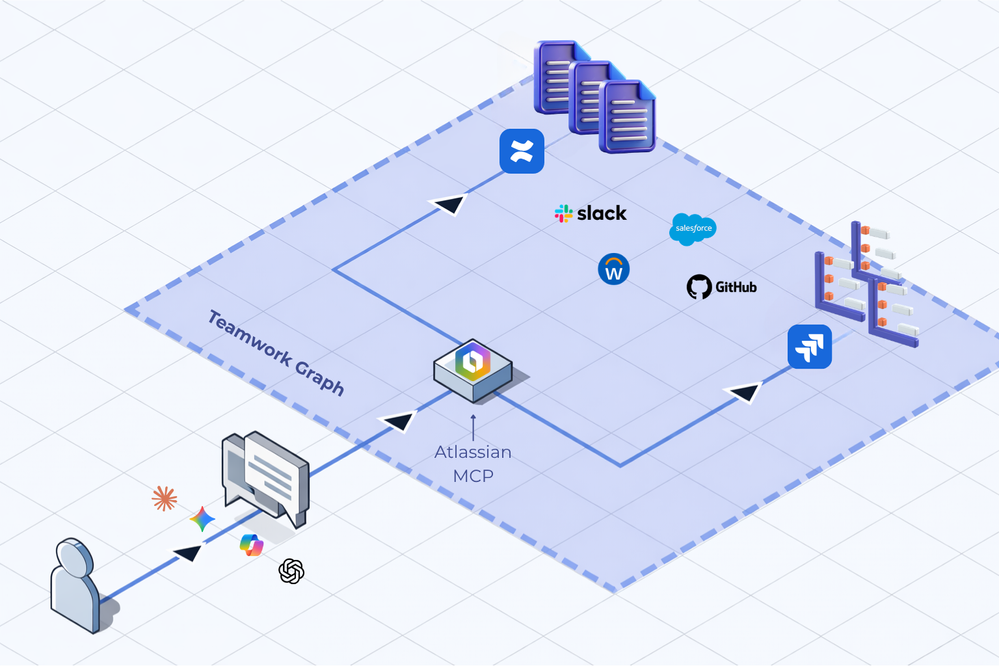
Artificial Intelligence has rapidly evolved from a fascinating research topic into an essential component of modern software engineering. Only a few years ago, developers were amazed by AI-powered code completion. Today, enterprise teams expect AI assistants to understand source code, interpret Jira issues, summarize Confluence documentation, analyze test failures, review pull requests, and even suggest architectural improvements.
This evolution represents a fundamental shift. Modern AI is no longer evaluated solely by the intelligence of its language model. Instead, its effectiveness depends on its ability to access and reason over the right context.
Imagine asking an AI assistant:
“Why did yesterday’s regression pipeline fail?”
A generic chatbot has no knowledge of your organization. It cannot inspect your CI/CD pipelines, analyze BrowserStack execution logs, read Jira defects, or correlate recent pull requests.
An enterprise AI assistant, however, can answer this question because it has access to your software ecosystem.
This is where the Model Context Protocol (MCP) becomes a game changer.
Rather than relying on isolated prompts, MCP enables AI models to securely connect with enterprise systems and retrieve the information required to produce accurate, context-aware responses.
In this article, we’ll explore how this emerging protocol is transforming software development and testing, and how leading tools such as Jira Rovo, BrowserStack AI, GitHub Copilot, Cursor, GitLab Duo, Amazon Q Developer, and others are embracing contextual intelligence.
The Evolution of AI in Software Engineering
The role of AI in software development has evolved through several distinct phases.
Phase 1 – Code Completion
The first generation of developer assistants focused on productivity.
Tools analyzed nearby code and suggested the next few lines.
Capabilities included:
- syntax completion
- boilerplate generation
- variable suggestions
- documentation snippets
Although useful, these assistants had no understanding of the broader project.
Phase 2 – Code Generation
Large Language Models fundamentally changed developer expectations.
Instead of completing code, developers could describe a requirement in natural language.
For example:
“Create a REST API endpoint using Spring Boot that validates JWT tokens.”
Within seconds, an AI assistant could generate an initial implementation.
However, these models still lacked organizational awareness.
They didn’t know:
- coding conventions
- architecture decisions
- internal frameworks
- deployment pipelines
- testing standards
Every prompt started with limited context.
Phase 3 – Context-Aware AI
Enterprise software development requires much more than code generation.
Developers interact daily with dozens of systems:
- Git repositories
- Jira
- Confluence
- CI/CD platforms
- BrowserStack
- Kubernetes
- Docker
- Slack
- Monitoring tools
- Cloud platforms
- Internal documentation
Each of these systems contains valuable knowledge.
Without access to this information, even the most capable language model operates with significant blind spots.
The challenge, therefore, is not simply building a smarter model.
The challenge is providing the model with the right information at the right moment.
Why Context Matters More Than Intelligence
Suppose two AI assistants are available.
Assistant A is powered by one of the world’s most advanced language models.
Assistant B uses a slightly smaller model but has access to:
- Your GitHub repository
- Jira backlog
- BrowserStack executions
- Confluence documentation
- Deployment history
- Production incidents
Which assistant is more likely to answer:
“Why are login tests suddenly failing in production?”
The answer is obvious.
Context consistently outperforms raw intelligence.
This principle is becoming one of the most important trends in enterprise AI.
The most valuable assistants are no longer those with the largest parameter count—they are the ones that understand the environment in which they operate.
Understanding Model Context Protocol (MCP)
Model Context Protocol is an open protocol designed to standardize how AI models interact with external systems.
Instead of every AI platform building proprietary integrations for every application, MCP introduces a common interface.
Think of it as a universal communication layer between AI assistants and enterprise tools.
Rather than asking:
“Can this model connect to Jira?”
The question becomes:
“Does Jira expose an MCP server?”
Likewise:
- BrowserStack
- GitHub
- GitLab
- PostgreSQL
- Kubernetes
- Docker
- Slack
- internal business applications
can all expose contextual information through a standardized protocol.
This significantly reduces integration complexity while enabling AI assistants to access information securely and consistently.
A Simple Mental Model
Imagine an experienced software engineer joining your company.
On their first day, they know programming languages and software design principles.
However, they know nothing about:
- your repositories
- architecture
- release process
- documentation
- testing framework
- production environment
As they gain access to these resources, they become increasingly effective.
LLMs behave similarly.
The model provides reasoning and language capabilities.
MCP provides organizational knowledge.
Together, they create an AI assistant that can understand both language and context.
Core Components of MCP
A typical MCP ecosystem consists of three main elements.
MCP Client
The AI application responsible for initiating requests.
Examples include AI coding assistants or enterprise chat interfaces.
Its responsibilities include:
- receiving user requests
- orchestrating multiple context sources
- interacting with the language model
- presenting responses
MCP Server
An MCP server acts as an adapter between enterprise systems and AI clients.
Examples include servers connected to:
- Jira
- Confluence
- GitHub
- BrowserStack
- PostgreSQL
- Docker
- Kubernetes
- internal APIs
Instead of exposing raw APIs, the server provides structured, AI-friendly context.
Language Model
The language model remains responsible for:
- reasoning
- summarization
- explanation
- planning
- code generation
- documentation
- decision support
Its responses become dramatically more accurate because they are grounded in real organizational data rather than assumptions.
Why MCP Represents a Paradigm Shift
For years, enterprise AI integrations relied on custom plugins, bespoke APIs, or manually engineered prompt pipelines.
These approaches often suffered from:
- duplicated integration effort
- inconsistent security models
- fragile prompt engineering
- vendor lock-in
- limited interoperability
MCP addresses these challenges by introducing a standardized layer for contextual access. Instead of creating a unique connector for every AI tool and every enterprise application, organizations can expose trusted context once through an MCP server and allow multiple AI clients to consume it.
This architectural shift encourages interoperability, reduces maintenance overhead, and makes it easier to integrate new AI assistants into existing development and QA ecosystems.