
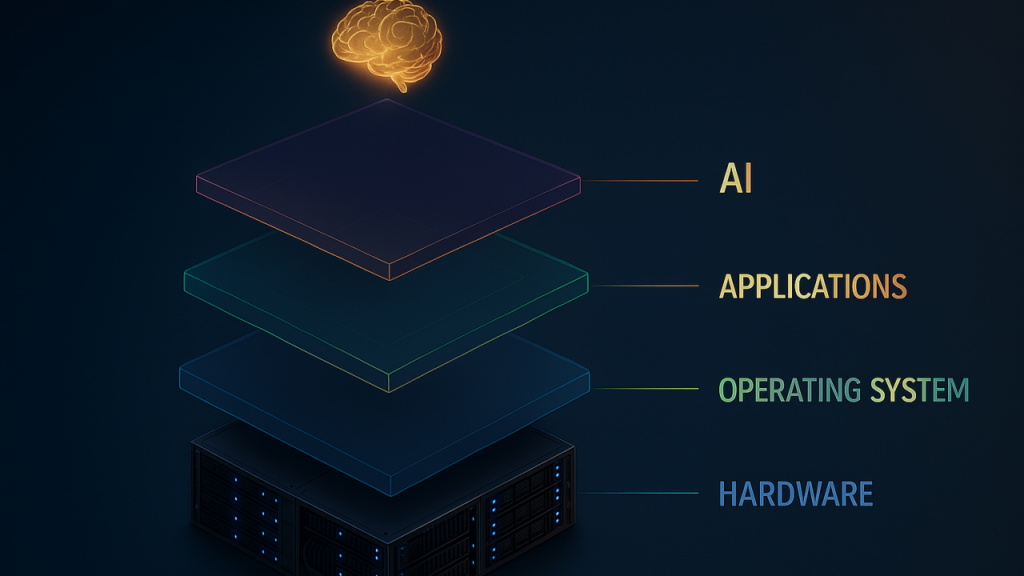
The real problem behind AI adoption
Most organizations believe they are “building AI systems”.
In reality, they are building:
A collection of prompts wrapped in APIs, deployed without architecture
This creates a fundamental mismatch between:
- What AI looks like (intelligent, fast, magical)
- And what it actually is in production (fragile, expensive, non-deterministic)
At scale, this leads to:
- Unpredictable outputs
- Exponential token consumption
- Untraceable behavior changes
- Zero governance on model usage
- Rising technical debt in prompt logic
The core issue is not model capability.
It is absence of system design thinking.
1. The root cause: Prompt-Centric Engineering
Anti-pattern: Prompt-Centric Architecture
Typical implementation:
- Prompts embedded in code
- No separation of concerns
- No versioning strategy
- No evaluation framework
- No abstraction layer over models
This leads to what can be called:
🧩 “Semantic Spaghetti Architecture”
Where intelligence logic is:
- Duplicated
- Inconsistent
- Untestable
- Unscalable
2. The paradigm shift: AI as a system, not a feature
To scale AI properly, we must move from:
“How do I call the model?”
to
“How do I design an intelligence system?”
3. Reference architecture for scalable AI systems
A production-grade LLM system should be decomposed into 6 architectural layers:
3.1 Input Normalization Layer
Purpose: standardize all incoming data
- Validation
- Sanitization
- Schema enforcement
- Noise reduction
Key principle:
Garbage in → expensive garbage out (in tokens)
3.2 Context Engineering Layer (most critical layer)
This layer defines what the model sees.
Includes:
- RAG (retrieval augmented generation)
- Memory injection
- Session state
- Domain constraints
- Tool outputs
Key insight:
70% of token cost is often wasted context
3.3 Orchestration Layer (brain of the system)
Responsible for:
- Routing requests
- Selecting model tier
- Deciding workflow paths
- Managing multi-step reasoning
This layer replaces “direct prompt calls” with decision logic
3.4 Reasoning Layer (LLM execution)
Here the model is treated as:
- Probabilistic engine
- Not deterministic function
Key design rule:
Never let the model decide the system flow
3.5 Validation Layer (critical for enterprise AI)
Ensures:
- Schema compliance
- Hallucination filtering
- Constraint enforcement
- Structured output verification
This layer transforms LLM output into safe system input
3.6 Output Layer
Handles:
- Formatting
- Downstream integration
- API transformation
- UI-ready structuring
4. The AI maturity model (real-world classification)
🧭 Level 0 — Chaos Prompting
- Scripts in notebooks
- No reuse
- No monitoring
🧭 Level 1 — API Wrapping
- Prompts in backend services
- Still unstructured
🧭 Level 2 — Modular Prompt System
- Reusable prompt templates
- Partial abstraction
🧭 Level 3 — Orchestrated AI System
- Routing layer
- Context separation
- Basic observability
🧭 Level 4 — Production AI Platform
- Full observability
- Cost control
- Governance
- Multi-model routing
- Evaluation pipelines
👉 Most companies are stuck between Level 1 and 2.
5. Model routing: the biggest hidden cost lever
The fundamental mistake:
Using the same LLM for every task
This leads to:
- Overpaying for simple tasks
- Unnecessary latency
- Token explosion
Correct approach: Task-to-model mapping
| Task type | Model class | Example |
|---|---|---|
| Classification | Small model | intent detection |
| Structuring | Medium model | summarization |
| Reasoning | Large model | debugging logic |
| Critical decisions | Large + validation layer | risk analysis |
6. Token economics inside AI systems
Token consumption is not linear in practice.
Main drivers of cost explosion:
- Large context injection
- Multi-turn conversation history
- Unbounded tool outputs
- Repeated system instructions
- Poor prompt compression
Token inefficiency patterns
- Duplicated instructions across prompts
- Verbose system messages
- Full document injection instead of retrieval filtering
- No summarization layer
7. AI observability: the missing discipline
Without observability, AI cannot be operated in production.
Required metrics:
- Tokens per request
- Cost per feature
- Model usage distribution
- Latency per routing path
- Retry rate per prompt version
- Hallucination frequency (estimated via sampling)
- Cache hit ratio
8. AI cost optimization framework
Layer 1 — Prompt optimization
- Reduce verbosity
- Enforce structured output
- Remove redundancy
Layer 2 — Context optimization
- Retrieval filtering
- Summarization before injection
- Chunk optimization
Layer 3 — Model optimization
- Routing logic
- Fallback models
- Hybrid architecture
Layer 4 — System optimization
- Caching layer
- Batching requests
- Async execution pipelines
9. Engineering principle summary
- AI is not a feature → it is a distributed system
- Prompts are not logic → they are configuration
- Models are not services → they are probabilistic engines
- Cost is not secondary → it is a design constraint
- Observability is not optional → it is mandatory
The real transformation
The future of AI engineering is not:
- Better prompts
- Bigger models
- More tokens
It is:
Architected intelligence systems with controlled cost, observable behavior, and deterministic orchestration layers