
For years, the context ai conversation was dominated by one question.
That focus shaped many discussions.
Which model should we use?
Then came another.
How do we write better prompts using context ai?
Today, a different question is becoming increasingly important.
What does the AI actually know about the environment in which it is supposed to operate?
This question matters because modern AI systems are moving beyond simple question-and-answer interactions.
They are reading repositories, analysing documents, navigating tools, generating code, querying systems, creating plans, and increasingly executing multi-step tasks.
In other words, AI is becoming operational.
And when AI becomes operational, context becomes infrastructure.
The Model Is Not the Whole System
Imagine two engineers using exactly the same AI model.
They have the same capabilities, the same token limits, and access to the same tools.
Yet one consistently gets useful results while the other receives generic, incomplete, or incorrect output.
It is tempting to conclude that one engineer is simply better at prompting.
Sometimes that is true.
But there is another explanation.
The AI may be operating with fundamentally different context.
Consider these two requests:
"Implement authentication."and:
"Implement authentication for this Spring Boot service.

Use the existing JWT mechanism.
Do not introduce a new security framework.
Authentication is handled by the API Gateway.
This service validates the propagated identity.
Follow the conventions in /docs/architecture.md.
Use the existing exception model.
Do not modify public API contracts.

Relevant examples:
- UserController.java
- SecurityConfig.java
- AuthExceptionHandler.java
The second request does not necessarily contain a better prompt.
It contains a better operating environment.
That distinction is becoming fundamental.
Prompt Engineering Has a Ceiling
Prompt engineering is useful.
But prompts are inherently temporary.
You can write:
"Act as a senior Java engineer..."Every morning.
You can repeat:
"Follow our coding conventions."In every conversation.
You can explain the architecture again.
And again.
And again.
Eventually, the problem becomes obvious.
The engineer is repeatedly reconstructing information that already exists somewhere else.
The architecture exists.
The conventions exist.
The repository exists.
The decisions exist.
The documentation exists.
The issue history exists.
The problem is that this knowledge is not necessarily assembled into a form the AI can reliably consume.
This is where context engineering becomes more important than prompt engineering alone.
What Is Context Engineering?
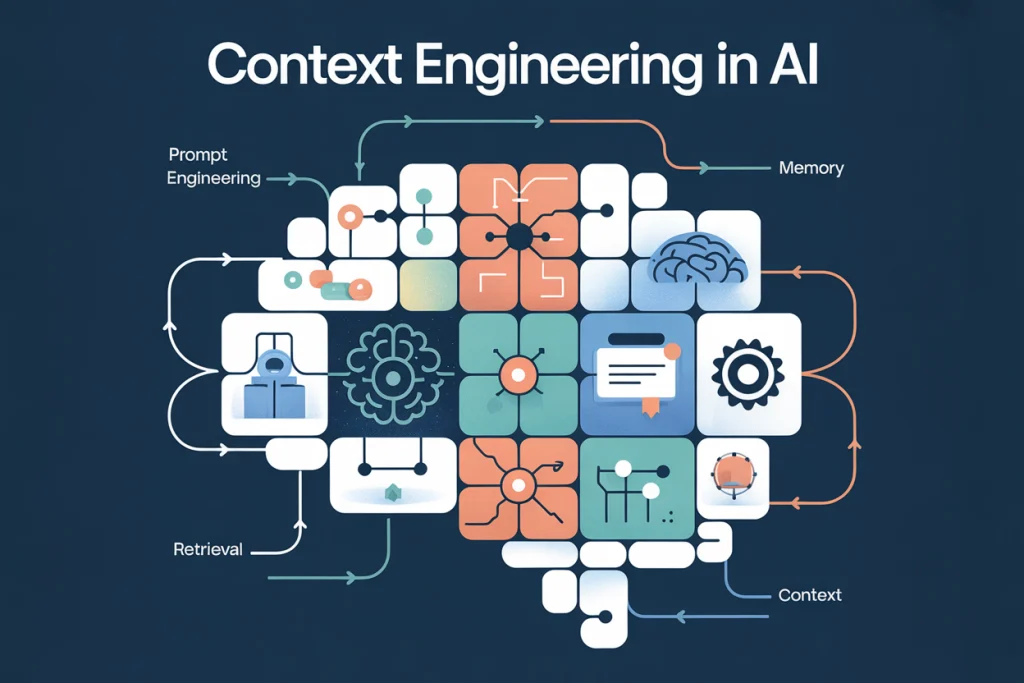
Context engineering is the deliberate design of the information an AI system receives before it performs a task.
It includes more than instructions.
Context can contain:
- Project architecture
- Source code
- API contracts
- Coding conventions
- Business rules
- Technical decisions
- Documentation
- Examples
- Constraints
- Dependencies
- Historical decisions
- Current state
- Previous actions
- Tool outputs
A useful abstraction is:
                     ┌──────────────┐
                     │    Sources   │
                     └──────┬───────┘
                            ↓
                     ┌──────────────┐
                     │    Context   │
                     │     Layer     │
                     └──────┬───────┘
                            ↓
                     ┌──────────────┐
                     │     Agent     │
                     └──────┬───────┘
                            ↓
                     ┌──────────────┐
                     │    Action     │
                     └──────┬───────┘
                            ↓
                     ┌──────────────┐
                     │   Feedback    │
                     └──────┬───────┘
                            │
                            └──────→ Context
The important component is the layer in the middle.
Context Is Not Just More Information
This is where many implementations go wrong.
More context does not automatically mean better context.
Imagine giving an agent:
- 400 pages of documentation
- 200 Jira tickets
- 50 source files
- 20 architecture diagrams
- 10 obsolete specifications
and telling it:
“Figure it out.”
That is not context engineering.
That is context accumulation.
Useful context should be:
Relevant + current + consistent + structured + accessible.
A 20-line architecture decision can be more valuable than 200 pages of outdated documentation.
Introducing Context Debt
Organisations already understand:
- Technical debt
- Documentation debt
- Data debt
- Security debt
There is another form of debt emerging:
Context Debt
Context debt is the accumulation of missing, outdated, fragmented, contradictory, or inaccessible knowledge that makes AI-assisted work less reliable.
Consider a typical project.
The actual architecture is:
Source code        → GitLab
Architecture       → Confluence
Decisions          → Jira
API documentation → Swagger
Deployment         → Kubernetes
Business rules     → tickets + emails
Known constraints  → people's memory
A human engineer can navigate this ecosystem.
An AI agent cannot reliably do so unless the relevant information is made available in the right context.
The organisation has knowledge.
But the knowledge is fragmented.
That is context debt.
The Four Forms of Context Debt
1. Missing Context
The required information simply does not exist.
Example:
“Why does this service require this unusual timeout?”
Nobody knows.
The implementation exists, but the reason does not.
An AI agent sees the code.
It cannot see the original decision.
2. Fragmented Context
The information exists but is distributed across multiple systems.
For example:
Architecture → Confluence
Implementation → Git
Requirement → Jira
Exception → Slack
Operational constraint → someone's memory
The information is available to humans who know where to look.
It is much harder to use systematically.
3. Stale Context
The documentation says:
API version: 3The application runs:
API version: 5The agent receives both.
Now it has context, but contradictory context.
More information has made the system less reliable.
4. Implicit Context
Some of the most important rules are never documented.
Experienced engineers simply know them.
For example:
“We don’t touch this module because another system depends on its legacy behaviour.”
That knowledge might exist only in someone’s head.
When that person changes teams, the organisation loses context.
AI exposes this problem because an agent cannot reliably infer organisational memory.
The AI-Readable Codebase
We have spent decades making software understandable to computers.
We use:
- APIs
- Schemas
- Contracts
- Configuration
- Metadata
- Structured logs
But our engineering knowledge is still largely written for humans.
This creates an emerging question:
Is your codebase understandable not only to engineers, but also to AI agents?
An AI-readable codebase does not mean filling the repository with AI-generated documentation.
It means making important engineering context:
- Explicit
- Structured
- Discoverable
- Current
- Locally relevant
Examples include:
README.md
ARCHITECTURE.md
CONTRIBUTING.md
AGENTS.md
docs/
adr/
api/
examples/
The exact filenames are less important than the principle.
The repository should contain enough reliable context for an agent to understand how the system is supposed to evolve.
Context Should Have an Architecture
A mature AI-enabled engineering organisation may eventually need something similar to an application architecture for context itself.
For example:
                    Context Layer

       ┌─────────────────────────────────┐
       │ Project Instructions             │
       ├─────────────────────────────────┤
       │ Architecture & ADRs             │
       ├─────────────────────────────────┤
       │ Coding Conventions              │
       ├─────────────────────────────────┤
       │ APIs & Contracts                │
       ├─────────────────────────────────┤
       │ Current Work / Issues           │
       ├─────────────────────────────────┤
       │ Runtime & Environment State     │
       └─────────────────────────────────┘
                         ↓
                     AI Agent
Different tasks require different slices of this context.
A documentation task does not need the entire runtime state.
A deployment task does.
A refactoring task needs architecture and coding conventions.
A production investigation needs operational context.
The goal is therefore not:
Give the AI everything.
It is:
Give the AI the right context for the task.
Context Has a Cost
Context is not free.
More information can mean:
- Higher token consumption
- Slower processing
- Greater retrieval complexity
- Contradictory instructions
- Lower signal-to-noise ratio
- More opportunities for irrelevant information to influence the result
This means context itself needs optimisation.
A useful question becomes:
What is the minimum reliable context required to perform this task correctly?
That is very different from:
“How much information can we give the model?”
Context Quality Can Be Managed
I would evaluate important context using five dimensions:
| Dimension | Question |
|---|---|
| Relevance | Is this information useful for the current task? |
| Freshness | Is it still valid? |
| Authority | Is this the trusted source? |
| Structure | Can the information be interpreted consistently? |
| Traceability | Can we understand where it came from? |
This turns context from an informal concept into something engineering teams can actively manage.
Context Versioning
There is another interesting consequence.
If context influences AI-generated changes, then context itself becomes part of the engineering state.
Imagine:
Code version:       8f32a1
Context version:    2026.09
Model:              X
Tools:              Y
The same request processed six months later may produce a different result because the context changed.
This means reproducibility for AI-assisted engineering may eventually require more than source-code versioning.
We may also need to know:
Which context produced this decision?
The Context Layer as Organisational Infrastructure
This leads to a broader idea.
Organisations traditionally store knowledge in separate systems:
Code
Tickets
Documents
Monitoring
Chats
Wikis
Databases
AI agents increasingly need to connect these worlds.
The organisation therefore starts building something new:
a context layer between organisational knowledge and machine action.
That layer does not necessarily need to be one product.
It can be a combination of:
- Repositories
- Documentation
- APIs
- Connectors
- Retrieval systems
- Structured metadata
- Agent instructions
- Access controls
- Knowledge graphs
- Runtime information
The architecture will differ by organisation.
The principle remains the same.
The Competitive Advantage May Move Up the Stack
AI models are becoming increasingly accessible.
Companies can often use similar models.
Similar coding assistants.
Similar agent frameworks.
Similar APIs.
If everyone has access to comparable intelligence, differentiation may increasingly come from what surrounds the model.
Consider:
Model
   +
Tools
   +
Context
   +
Data
   +
Processes
   +
Feedback
The model is only one component.
The surrounding system determines what the model can actually accomplish.
What Engineers Should Do Now
You do not need to build a sophisticated AI platform tomorrow.
Start smaller.
1. Document decisions, not just implementations
Explain why something exists.
2. Put critical conventions close to the code
Don’t force every engineer—or every agent—to search five systems.
3. Remove contradictory documentation
Outdated information is sometimes worse than missing information.
4. Structure project context
Separate architecture, conventions, constraints, APIs, and operational information.
5. Treat context as a maintained asset
If nobody owns it, it will become stale.
6. Measure failures caused by missing context
When an AI-generated change is wrong, ask:
Was the model wrong—or was the necessary context unavailable?
That distinction is extremely valuable.
The Next Engineering Layer
The first era of AI-assisted development was largely about:
Can AI generate code?
The next question is:
Can AI understand our engineering environment well enough to act safely and consistently?
That is a context problem.
And context is not merely prompt text.
It is architecture.
It is documentation.
It is organisational memory.
It is system state.
It is knowledge management.
It is infrastructure.
The companies that understand this distinction will not simply have better prompts.
They will have better environments for AI to operate in.
The AI race is often described as a race between models.
But models are only part of the equation.
A highly capable model with poor context can produce mediocre results.
A capable model operating inside a well-designed context layer can become dramatically more useful.
So perhaps the most important question for an AI-enabled engineering organisation is no longer:
“Which model should we use?”
It is:
“What does our AI need to know before we ask it to act?”
Because in the AI engineering era:
Context is no longer background information.
Context is infrastructure.