
Moving from AI-assisted prototyping to secure, reliable and production-ready applications.
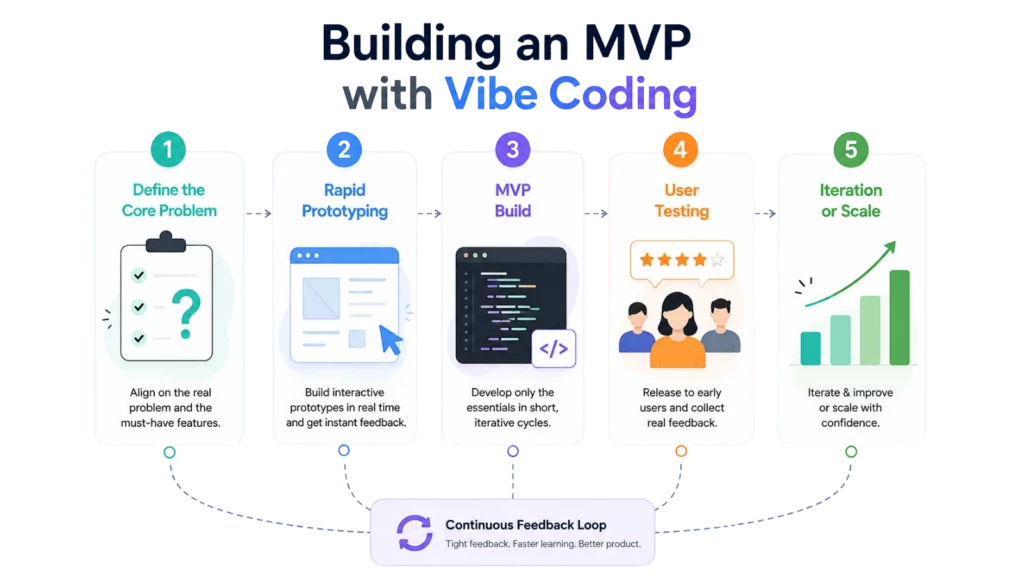
Building an application has never been more accessible.
With the rise of AI-powered development tools, developers can now describe an idea in natural language and obtain a working application within hours. Tools such as GitHub Copilot, Cursor and Claude Code are changing how software is designed, implemented and delivered.
This evolution, commonly associated with Vibe Coding, is lowering the barrier to software development and accelerating experimentation.
However, there is an important distinction between generating an application and engineering a reliable product.
A prototype may demonstrate that an idea works. It does not necessarily demonstrate that the application is secure, maintainable, scalable or trustworthy.
This distinction becomes even more important when artificial intelligence is part of the application itself.
Building a successful AI Minimum Viable Product (MVP) therefore requires more than selecting a model and writing a few prompts. It requires a structured approach that combines product validation, architecture, data protection, AI security, software quality and governance.
The objective is not to build an enterprise-scale platform from day one. It is to build the smallest valuable solution that can be tested, evaluated and improved without introducing unnecessary risks.
1. Understanding the AI MVP: Beyond the Proof of Concept
An AI MVP is a limited but usable implementation of an application that leverages artificial intelligence to solve a clearly identified problem.
It should validate three fundamental assumptions:
- Business value: Does the application solve a real user problem?
- Technical feasibility: Can the selected AI technology deliver acceptable results?
- Operational viability: Can the solution operate securely, reliably and at an acceptable cost?
An MVP should not be confused with a Proof of Concept (PoC).
A PoC primarily validates technical feasibility. An MVP goes further by delivering a limited user-facing experience that can generate meaningful feedback.
A production-ready solution introduces additional expectations, including operational resilience, formal security controls, monitoring, support and organizational governance.
The MVP is therefore a learning instrument, not an excuse to bypass engineering discipline.
2. Define the Problem Before Choosing the Model
One of the most common mistakes in AI development is starting with a model or framework instead of a business problem.
Before selecting an LLM, RAG architecture or autonomous agent, define the actual task.
For example, consider an internal knowledge assistant designed to help employees retrieve information from technical documentation.
A first MVP could provide:
- Document ingestion.
- Semantic search.
- Context-aware answers.
- Source references.
- User feedback.
- Basic access management.
There is no immediate need for multiple autonomous agents, complex orchestration or fine-tuning.
The initial scope should be deliberately narrow.
Define measurable success criteria such as:
| Dimension | Example KPI |
|---|---|
| Answer quality | Grounded answer rate |
| Retrieval | Relevant document retrieval rate |
| Reliability | Successful request rate |
| Performance | P95 response latency |
| Security | Unauthorized access incidents |
| Cost | Average cost per request |
| User experience | User satisfaction score |
These metrics establish a baseline against which future improvements can be evaluated.
3. Select the Right AI Architecture
The architecture should reflect the problem, data sensitivity, expected traffic and operational constraints.
Three common approaches deserve consideration.
Option A: LLM-based application
An application sends a user request to a language model through an API and returns the generated response.
This is appropriate for summarization, classification, content generation and conversational interfaces.
Option B: Retrieval-Augmented Generation (RAG)
RAG combines information retrieval with language generation.
Instead of relying exclusively on the model’s internal knowledge, the application retrieves relevant information from an authorized knowledge source and provides it as context.
A typical architecture includes:
- Document ingestion and processing.
- Text chunking and embedding generation.
- Vector storage and retrieval.
- Context construction.
- LLM inference.
- Response validation and source attribution.
RAG is particularly useful for internal knowledge assistants, technical documentation search and enterprise information retrieval.
However, RAG does not automatically guarantee factual accuracy or data confidentiality. Retrieval permissions, document provenance and context isolation must be enforced independently.
Option C: Agentic AI
An AI agent can plan tasks, invoke tools, retrieve information and execute actions.
This approach is appropriate when a problem requires multiple coordinated operations rather than a single generated response.
However, introducing autonomous actions increases the application’s security and testing requirements.
For a first MVP, prefer the simplest architecture that meets the business objective.
4. Security by Design: Protect the MVP from Day One
Security should be considered during architecture design, not postponed until deployment.
AI applications introduce traditional application security risks as well as vulnerabilities associated with prompts, model behavior, retrieval pipelines and external integrations.
4.1 Protect sensitive data
Start by identifying what information enters the application.
Classify data according to its sensitivity and business requirements.
Apply the following practices:
- Collect only the data required for the use case.
- Avoid sending confidential information to unapproved external AI providers.
- Apply data minimization and retention policies.
- Encrypt sensitive information in transit and at rest.
- Prevent sensitive information from appearing in application logs.
- Define appropriate deletion and access procedures.
Data protection must cover the complete lifecycle, including prompts, retrieved documents, model responses, logs and backups.
4.2 Secure credentials and API integrations
Never hardcode API keys, passwords or tokens in source code, prompts or configuration files committed to version control.
Use a secrets manager or an approved secure credential store.
Additionally:
- Apply authentication and authorization.
- Enforce role-based access control where appropriate.
- Use least-privilege service accounts.
- Validate API requests and responses.
- Apply rate limits and resource quotas.
- Restrict network access to required services.
4.3 Address prompt injection
Prompt injection occurs when malicious instructions influence the behavior of an AI system.
An attacker may attempt to manipulate the model through direct user input or indirect content embedded in documents, websites or retrieved information.
For example, a document indexed by a RAG application may contain instructions attempting to override the intended system behavior.
Useful mitigations include:
- Treat retrieved content as untrusted input.
- Separate system instructions from retrieved information.
- Restrict the operations available to the model.
- Validate tool arguments independently.
- Enforce authorization outside the LLM.
- Require human approval for sensitive actions.
An important principle is that prompts are not security boundaries. Access control must be enforced by deterministic application components.
4.4 Validate AI-generated outputs
A language model can produce incorrect, misleading or potentially dangerous content.
Never assume that a generated response is safe simply because it is syntactically valid.
Depending on the application, implement:
- Output schema validation.
- HTML and input sanitization.
- Business-rule validation.
- Source verification.
- Content filtering.
- Human review for high-impact decisions.
The model should assist decision-making, not silently replace the application’s security controls.
5. Quality Engineering for AI Applications
Traditional software testing remains essential, but AI introduces additional dimensions of quality.
A successful response is not necessarily a correct response.
An AI testing strategy should combine conventional software verification with systematic evaluation of model behavior.
Functional testing
Verify user journeys, API contracts, authentication, authorization and business rules.
AI output evaluation
Create a representative evaluation dataset containing:
- Expected answers.
- Relevant source documents.
- Edge cases.
- Ambiguous questions.
- Out-of-scope requests.
- Adversarial inputs.
Evaluate correctness, relevance, groundedness and consistency.
Security testing
Test prompt injection, sensitive information disclosure, unauthorized retrieval, insecure output handling and excessive permissions.
Performance and cost testing
Measure latency, throughput, token consumption, resource utilization and cost per transaction.
Regression testing
Model updates, prompt changes, embedding changes and retrieval configuration updates can affect application behavior.
Maintain versioned evaluation datasets and repeat relevant tests before releasing changes.
A useful release gate should consider multiple dimensions:
Functional correctness + AI quality + Security + Performance + Cost
A system should not pass simply because its functional tests are green.
6. ISO Standards: Building an AI MVP with Governance in Mind
International standards provide useful frameworks for introducing structured governance, risk management and security practices into AI development.
The following references are particularly relevant.
ISO/IEC 42001:2023 — Artificial Intelligence Management System
ISO/IEC 42001 defines requirements for establishing, implementing, maintaining and continually improving an Artificial Intelligence Management System (AIMS).
It provides an organizational framework for responsible AI development and use.
For an AI MVP, its principles can support:
- Defined AI responsibilities.
- Governance policies.
- Risk management processes.
- Documentation and traceability.
- Monitoring and continual improvement.
ISO/IEC 23894:2023 — AI Risk Management
This standard provides guidance on managing risks associated with AI systems.
It is particularly useful for identifying risks related to data quality, model behavior, transparency, reliability and potential impacts on users.
Risk assessment should begin during use-case definition and continue throughout the lifecycle.
ISO/IEC 27001:2022 — Information Security Management
ISO/IEC 27001 provides requirements for an Information Security Management System (ISMS).
Its principles are relevant to the protection of:
- Application data.
- Infrastructure.
- User identities.
- Credentials.
- APIs.
- Operational environments.
ISO/IEC 42005:2025 — AI System Impact Assessment
This standard addresses the assessment of impacts associated with AI systems.
It helps organizations consider the consequences of AI deployment for individuals, groups and society.
It becomes especially relevant when an application influences decisions, processes personal data or affects users in meaningful ways.
ISO/IEC 5338:2023 — AI System Lifecycle Processes
This standard provides processes for the AI system lifecycle.
It offers a useful reference for structuring development, validation, deployment, operation and maintenance activities.
These standards should be treated as complementary references, not as a checklist that automatically makes an application compliant.
Implementing an MVP does not itself establish ISO certification. Certification and conformity assessments require a broader organizational and contextual evaluation.
7. From MVP to Production: A Practical Roadmap
A controlled implementation can be organized into six stages.
Stage 1 — Discover
- Identify the business problem.
- Define target users.
- Select the AI use case.
- Establish success criteria.
Stage 2 — Assess
- Classify data.
- Identify security threats.
- Assess AI-related risks.
- Define privacy and governance requirements.
Stage 3 — Design
- Select the model and architecture.
- Define integration boundaries.
- Implement authentication and authorization.
- Establish data protection controls.
Stage 4 — Build
- Develop the minimum feature set.
- Secure credentials and APIs.
- Version prompts and configurations.
- Integrate automated quality checks.
Stage 5 — Validate
- Execute functional tests.
- Evaluate AI responses.
- Perform security testing.
- Measure performance and cost.
- Document identified limitations.
Stage 6 — Operate and Improve
- Monitor application behavior.
- Track quality and security metrics.
- Manage incidents.
- Re-evaluate risks after significant changes.
- Collect user feedback.
8. The Secure AI MVP Checklist
Before considering an AI MVP ready for external users, verify the following:
- The business problem and intended users are clearly defined.
- The selected AI approach is justified.
- Data sources are identified and classified.
- Sensitive information is appropriately protected.
- API keys and credentials are securely managed.
- Authentication and authorization are enforced.
- Prompt injection and data leakage scenarios are tested.
- AI outputs are validated before downstream processing.
- Evaluation datasets and quality thresholds are defined.
- Performance and AI consumption costs are monitored.
- Security risks and mitigation decisions are documented.
- Monitoring and incident response procedures exist.
- Human oversight is defined where necessary.
AI-assisted development has dramatically reduced the time required to transform an idea into a working application.
But development speed should never be confused with engineering maturity.
A successful AI MVP is not simply an application that generates convincing responses or demonstrates an impressive prototype. It is a solution that addresses a real problem, produces measurable value and operates within clearly defined security and quality boundaries.
Vibe Coding can accelerate the first implementation. AI Engineering, Quality Engineering and Security by Design make that implementation sustainable.
The real competitive advantage will not belong exclusively to those who build AI applications faster. It will belong to those who can build them responsibly, validate their behavior and earn the trust of their users.
Build fast. Validate continuously. Secure by design.
References and Further Reading
- ISO/IEC 42001:2023 — Artificial Intelligence Management Systems
- ISO/IEC 23894:2023 — Artificial Intelligence Risk Management
- ISO/IEC 27001:2022 — Information Security Management
- ISO/IEC 42005:2025 — AI System Impact Assessment
- ISO/IEC 5338:2023 — AI System Lifecycle Processes
- OWASP GenAI Security Project
- NIST AI Risk Management Framework