
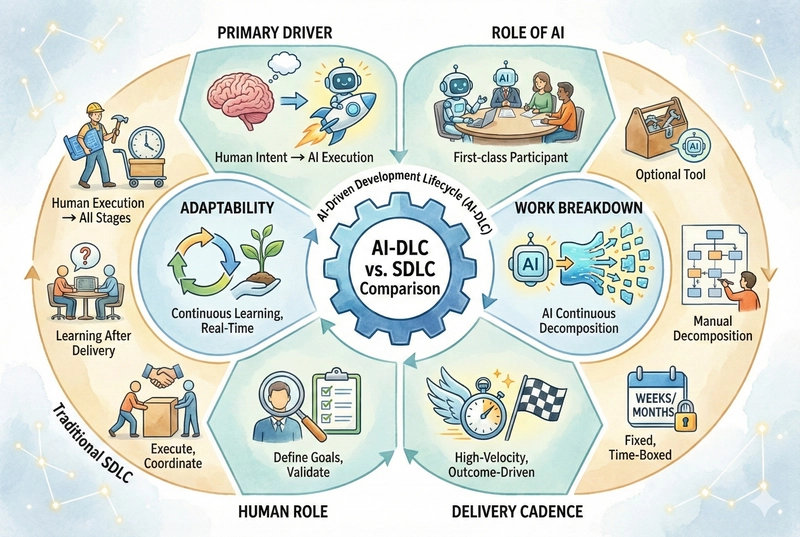
For the past few years, the software engineering conversation has been dominated by a seemingly simple question: how much code can AI generate?
AI coding assistants can now produce entire functions, create test suites, explain unfamiliar codebases, refactor legacy components, and suggest fixes for complex failures. With agentic capabilities, they can also execute commands, modify files, inspect repositories, and coordinate multiple steps toward a development objective.
Yet a fundamental challenge remains.
Generating code is only one part of building reliable software. Requirements must be understood, architectural decisions must remain coherent, dependencies must be managed, tests must establish meaningful confidence, and deployments must be operationally sound.
As AI becomes capable of handling more development activities, the central engineering challenge is shifting from generating individual artifacts to coordinating the entire process that produces them.
This is the problem that AI-DLC, or AI-Driven Development Life Cycle, seeks to address.
Rather than treating AI as an assistant invoked whenever a developer needs help, AI-DLC introduces a structured approach to organizing software development around collaboration between humans and AI agents.
The distinction is significant. The next step in AI-assisted engineering is not simply to write better prompts. It is to design a development process in which AI-generated work remains contextual, traceable, reviewable, and verifiable.
1. The limitations of prompt-driven development
Consider a common development workflow.
A developer describes a feature to an AI assistant. The assistant generates an implementation, creates a few tests, and reports success. The developer reviews the changes, corrects some mistakes, and moves the implementation into the delivery pipeline.
For a small, well-understood task, this approach can be highly effective.
The difficulty appears when the task crosses multiple engineering boundaries.
A seemingly simple feature might require changes to an API contract, a database model, authentication rules, application configuration, integration tests, deployment manifests, and monitoring.
If the agent receives insufficient context, it may make locally reasonable decisions that conflict with the architecture. If the task is too broad, assumptions become difficult to identify. If verification is left until the end, correcting an early misunderstanding may require reworking several downstream artifacts.
Repeated prompting can help, but it does not automatically solve the underlying problem.
A conversation is not necessarily a reliable engineering process. It may contain decisions that are difficult to trace, assumptions that were never validated, and outputs that depend on context no longer available to the next agent.
The challenge is therefore not just improving the intelligence of the model. It is improving the structure within which that intelligence operates.
2. What AI-DLC changes
AI-DLC reframes development as a sequence of coordinated activities rather than a collection of independent AI-assisted tasks.
The AWS Labs AI-DLC methodology illustrates this approach through five phases: Initialization, Ideation, Inception, Construction, and Operation. Work progresses through defined stages that produce artifacts and establish verification points before subsequent activities rely on their outputs.
The precise stages executed depend on the project scope and workflow configuration. The underlying principle remains consistent: development should advance through explicit, reviewable steps rather than depend on an agent’s claim that a task is complete.
Initialization: Establish the working context
Before an agent starts changing a system, it needs a reliable understanding of its environment.
Initialization establishes the workspace and the state required to manage the workflow. In an existing repository, this also means recognizing the project structure, conventions, tooling, and relevant constraints before proposing changes.
This phase addresses a common weakness in AI-assisted engineering: treating each task as if it existed independently of the system in which it must operate.
A technically valid code change can still be a poor engineering decision if it ignores the project’s architecture, security requirements, or delivery practices.
Ideation: Clarify what should be built
Business requests are often incomplete by design. They describe an expected outcome without specifying every functional rule, constraint, or edge case.
Ideation helps transform initial intent into a sufficiently clear and agreed direction.
The process may involve clarifying assumptions, identifying stakeholders, exploring feasibility, defining scope, and establishing the conditions under which the work should proceed.
This is particularly important when agents can generate plausible implementations from ambiguous instructions. Plausibility is not evidence that the agent understood the intended behavior.
Human involvement is especially valuable when decisions affect business rules, scope, risk, or competing stakeholder expectations.
Inception: Turn intent into an engineering plan
Inception connects the requested outcome to the system that must deliver it.
Depending on the scope, this can involve analyzing an existing codebase, refining requirements, defining user stories, establishing architecture, identifying dependencies, decomposing work into manageable units, and preparing a delivery plan.
The resulting artifacts provide a common reference for implementation and verification.
Instead of asking an agent to build an entire feature from a single instruction, the team establishes smaller units of work with explicit objectives and dependencies.
This decomposition has an important consequence: errors can be detected closer to the point where they originate.
If a design decision is incorrect, it can be challenged before it influences multiple implementation units. If a dependency is misunderstood, the delivery plan can be corrected before integration becomes expensive.
Construction: Build in controlled, verifiable increments
Construction is where designs become working software.
AI agents can contribute to functional design, non-functional requirements, infrastructure design, code generation, testing, and continuous integration activities, according to the selected scope and workflow.
However, implementation is not considered reliable merely because code has been generated.
The resulting software must satisfy the agreed requirements, respect architectural constraints, and pass the checks that matter for the change.
A useful implementation unit should have a defined purpose, relevant inputs, expected outputs, and explicit verification criteria.
This makes it possible to review the work incrementally rather than waiting until an entire feature has been assembled.
It also creates a better foundation for parallel execution. Independent work can be delegated when dependencies and integration boundaries are sufficiently clear, while tightly coupled tasks can remain sequential.
The objective is not to maximize the number of agents running simultaneously. It is to maximize useful progress without creating an integration and coordination problem that exceeds the benefits of parallelism.
Operation: Validate the software in its real environment
A development workflow should not end when the source code passes local tests.
Operation extends the lifecycle into deployment, environment provisioning, observability, incident preparedness, performance validation, and feedback, where applicable to the selected scope.
This matters because software behavior depends on more than implementation.
Configuration, identity and access management, network connectivity, external dependencies, infrastructure capacity, and runtime conditions can all affect the delivered result.
An agent can generate a valid deployment configuration while the resulting application remains unavailable. A successful deployment command does not necessarily demonstrate that critical business behavior works.
Operational verification connects engineering intent to the behavior of the deployed system.
Feedback then becomes an input to future development rather than an isolated post-release activity.
3. The real value lies in the artifacts between the phases
The most important part of a structured AI development lifecycle may be what exists between its activities.
Requirements, architectural decisions, work decomposition, test specifications, implementation changes, execution results, and operational findings form a chain of engineering evidence.
Each artifact should help answer three questions:
- What decision or requirement does this work address?
- What information and constraints were used to produce it?
- How can we determine whether the result is acceptable?
Without this chain, agents may produce individually convincing outputs that do not collectively form a coherent solution.
For example, a requirement can be correctly documented but implemented incorrectly. An implementation can match its design while violating an API contract. A test suite can pass while failing to cover a critical business rule.
Traceability makes these gaps easier to identify.
It also improves change management. When a requirement changes, the team can identify the related design decisions, implementation units, tests, and operational checks that may need to be revisited.
This is a major difference between generating artifacts and engineering a system.
4. AI-DLC does not eliminate human judgment
The increasing autonomy of AI agents can create the impression that human participation should progressively disappear from development.
That is the wrong objective.
Human involvement should evolve according to the importance of the decision, the reversibility of the action, and the level of confidence supported by the available evidence.
An agent may safely execute a routine formatting check without asking for approval. A change affecting authentication, data integrity, infrastructure permissions, or production availability deserves stronger controls.
The practical question is not whether every action requires human approval. Excessive approval gates can make a workflow unnecessarily slow.
The question is where human judgment provides meaningful risk reduction.
A mature AI-DLC implementation should distinguish between activities that can proceed automatically, activities that require review, and actions that need explicit authorization.
This allows teams to increase autonomy progressively instead of choosing between fully manual execution and unrestricted agent behavior.
5. Quality engineering must be integrated into the lifecycle
AI-DLC also changes how quality should be organized.
In traditional delivery models, QA can be perceived as a downstream activity that validates the output of development. In agent-driven workflows, waiting until implementation is complete to establish verification can be too late.
Quality needs to influence the work from the beginning.
During requirements analysis, teams should identify acceptance criteria, boundary conditions, negative scenarios, security expectations, and relevant non-functional requirements.
During design, they should identify integration risks, testability constraints, and the evidence needed to validate the architecture.
During construction, they should verify generated code, execute automated tests, review failures, and challenge assumptions that affect correctness.
During operation, they should validate critical behavior in the target environment and feed production observations back into the engineering process.
This does not mean adding a large testing phase to every task. It means selecting the appropriate verification activities according to risk and scope.
A small documentation change and a modification to an authorization mechanism should not require identical controls.
AI can help generate tests, analyze execution results, and identify missing scenarios. Nevertheless, the credibility of those results depends on whether the verification strategy is sufficiently independent of the assumptions used to produce the implementation.
6. The hidden bottleneck: engineering coordination
AI makes some engineering activities faster, but the overall delivery process remains constrained by dependencies and shared resources.
When implementation accelerates, other activities can become the bottleneck:
- Reviewing generated changes.
- Resolving conflicting architectural decisions.
- Integrating independently developed components.
- Maintaining reliable test environments.
- Investigating ambiguous failures.
- Validating security and operational readiness.
Imagine a team that doubles its implementation output but retains the same review capacity and integration process.
The result may be a larger queue of unreviewed changes, more merge conflicts, and a growing amount of work awaiting validation.
Local productivity has improved, but end-to-end delivery has not necessarily improved.
AI-DLC should therefore be evaluated as a system-level engineering approach.
Useful indicators include lead time from approved intent to validated delivery, rework caused by incorrect assumptions, first-pass verification rates, integration delays, escaped defects, and the effort required to review AI-generated changes.
The purpose is to understand whether the entire workflow is becoming more effective, not simply whether agents are producing more code.
7. Implementing AI-DLC without overengineering the process
Adopting a structured lifecycle does not require every team to introduce every stage, artifact, or agent immediately.
The implementation should reflect the project’s complexity and risk.
For a small change, a lightweight workflow may need only a clear objective, a limited implementation plan, automated checks, and a concise review.
For a complex enterprise feature, the process may require deeper requirements analysis, architectural decisions, dependency mapping, security and non-functional design, structured test evidence, and operational readiness checks.
The most practical adoption strategy is incremental.
Start with one representative workflow. Select a feature or engineering task that exposes the team’s current coordination challenges.
Make the inputs explicit. Define the requirements, repository context, constraints, and completion criteria available to the agents.
Create reviewable units of work. Break the task into changes that can be understood, verified, and integrated independently where possible.
Automate deterministic checks. Use existing build, test, static analysis, security, and deployment capabilities instead of relying exclusively on AI-generated assessments.
Introduce risk-based approval points. Reserve human intervention for decisions where it meaningfully improves safety or correctness.
Measure the complete outcome. Evaluate the time and effort required to deliver a verified change, including review, correction, integration, and operational validation.
Finally, review the process itself. If a stage creates no useful artifact, reduces no meaningful risk, and supports no important decision, its value should be questioned. Structure should improve engineering, not become bureaucracy.
8. The next evolution: engineering the system around the agents
AI-DLC points toward a broader change in software engineering.
For years, teams have optimized individual development activities through better IDEs, reusable libraries, automated pipelines, and testing frameworks.
Agentic development introduces another layer: the process that coordinates how work is understood, decomposed, executed, checked, and delivered.
This coordination layer needs its own engineering discipline.
Teams must define how agents receive context, how tasks are assigned, how dependencies are represented, how state is preserved, how artifacts are validated, and how permissions are enforced.
They must also decide which activities can be parallelized and which require sequential decisions or explicit approval.
These are not merely prompting questions. They are workflow architecture questions.
As agents become more capable, the quality of the surrounding process will increasingly determine whether their capabilities translate into reliable delivery.
Stop optimizing prompts. Start engineering the lifecycle.
AI-assisted coding has already changed the economics of producing software. AI-DLC addresses the next challenge: organizing that production into a disciplined, traceable, and verifiable engineering process.
Its value is not that every decision becomes automated or that every phase follows an inflexible sequence. Its value is that intent, planning, implementation, verification, and operation become connected through explicit artifacts and defined controls.
The result should be a development workflow in which agents can perform more work without leaving the team uncertain about what was built, why it was built, or whether it works.
The next competitive advantage will not belong exclusively to teams using the most powerful models or deploying the largest number of agents.
It will belong to teams that design the most effective relationship between AI capability, engineering process, and verifiable outcomes.
The future of AI-driven software engineering is not prompt-driven development at scale. It is process-driven engineering with AI agents operating inside a system designed for reliability.