
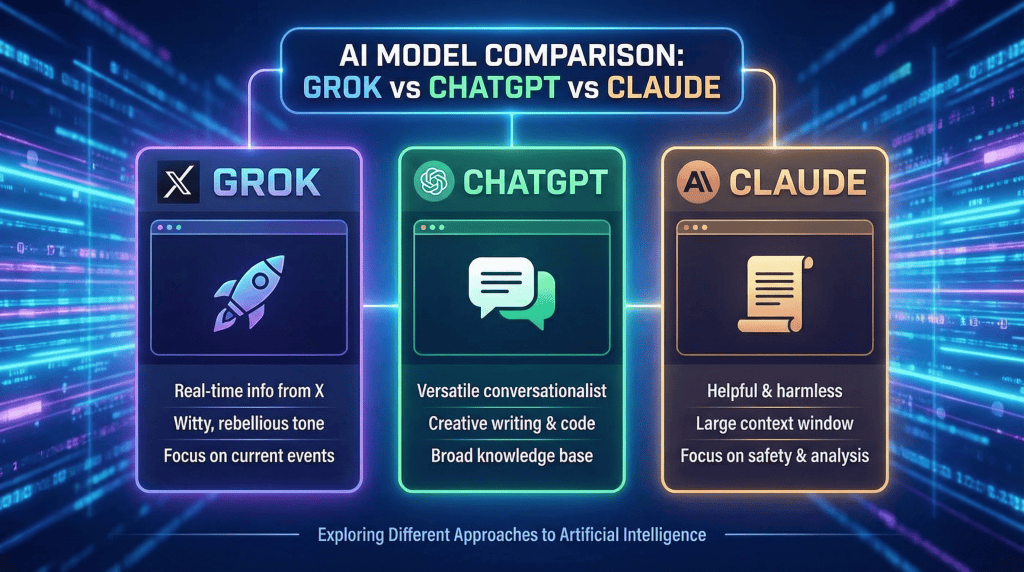
The AI model race is entering a different phase, with Agentic AI emerging.
For years, comparing models meant asking the same questions to different systems.
Which model writes better code, Agentic AI?
Which one reasons better?
Which one produces the most accurate explanation?
That approach becomes increasingly incomplete when AI systems stop behaving like chat interfaces and instead resemble Agentic AI.
An Agentic AI does not simply answer a question. It receives a goal, builds a plan, uses tools, observes the environment, makes decisions, recovers from failures, verifies its work, and potentially continues for minutes or hours without human intervention.
That changes what should be measured.
A model that produces an excellent answer in one turn may still be a mediocre agent if it repeatedly selects the wrong tool, loses track of the objective, fails to recover from an error, or declares success without verifying the outcome.
This is why the most interesting AI benchmark in 2026 is no longer simply:
Which model answers better?
It is:
Which model can reliably complete real work?
Frontier Models and Agentic AI
This article compares frontier models—GPT-6 Astra, GPT-6 Sol, GPT-6 Luna, Claude Opus 5.5, Claude Sonnet 5, and Grok 4.7—using Agentic AI.
1. The models entering the agent race
The current landscape contains several models with deliberately different capability, speed, and cost profiles.
OpenAI’s GPT-6 family includes GPT-6 Astra, GPT-6 Sol, and GPT-6 Luna. OpenAI describes Astra as its highest-capability model for difficult end-to-end work, Sol as a balance between intelligence and cost, and Luna as an efficient option for cost-sensitive, high-volume workloads. The family supports reasoning and tool-oriented workflows, including function calling, web search, file search and computer use.
Anthropic’s current high-end model is Claude Opus 5.5, introduced on September 22, 2026. Anthropic positions it for complex professional work, coding and long-running agents. Claude Sonnet 5 is also explicitly designed for agent work, including planning, browser and terminal tool use, autonomous execution, coding and knowledge work.
On the xAI side, Grok 4.7 is positioned for coding, agent tasks and knowledge work. Its API supports function calling, structured outputs, reasoning, web search, X search and code execution.
One clarification matters for anyone publishing a comparison today: Claude Sonnet 5.5 should not be presented as an available model yet. Sonnet 5 is available; the 5.5 version is not currently part of Anthropic’s announced available model lineup. Therefore, a fair current comparison should use Sonnet 5 and treat Sonnet 5.5 as a future update rather than inventing benchmark results.
2. Why traditional benchmarks are not enough
Traditional benchmarks are useful because they create controlled measurements.
But an agent system introduces another dimension: execution.
Consider a simple software-engineering task:
Find the failing test, identify the root cause, modify the implementation, run the relevant test suite, fix any regression, and provide a concise summary.
This is not one question.
It is a chain:
Understand → Plan → Inspect → Act → Observe → Reason → Correct → Verify → Report
An agent can fail at any point.
For example:
- It may understand the problem but choose the wrong file.
- It may select the correct tool but provide invalid parameters.
- It may modify the code correctly but forget to run the tests.
- It may see a failing test but misinterpret the failure.
- It may solve the original problem while introducing a regression.
- It may complete the task but incorrectly report success.
A benchmark that evaluates only the final textual response can miss most of these failures.
Agent evaluation therefore needs to measure the trajectory, not only the final answer.
3. A practical Agentic Evaluation Framework
A useful benchmark can be built around twelve dimensions.
1. Task Completion Rate
Did the agent actually complete the requested objective?
TCR = successfully completed tasks / total tasks
This should be the primary metric.
2. First-Attempt Success Rate
Did the agent succeed without requiring human correction?
This is especially valuable for autonomous workflows.
3. Tool Success Rate
How often did the agent select and invoke the appropriate tool correctly?
A powerful model with poor tool discipline can still become an unreliable agent.
4. Recovery Rate
When something went wrong, did the agent detect the failure and recover?
Recovery Rate = recovered failures / recoverable failures
This is one of the most important metrics for long-running agents.
5. Verification Rate
Did the agent verify the outcome instead of assuming success?
For example:
- Run tests after changing code
- Check deployment status after deployment
- Validate extracted information
- Confirm a browser transaction
- Compare expected and actual results
6. Human Intervention Rate
How often did a human need to intervene?
The goal is not necessarily zero intervention.
For high-risk operations, human approval may be the correct design.
7. Cost per Successful Task
Token pricing alone can be misleading.
The relevant measurement is:
How much does it cost to successfully complete the task?
A more expensive model that completes a task in fewer attempts may sometimes have a lower effective cost than a cheaper model that requires repeated retries.
8. Latency
How long does the agent take to complete the mission?
For interactive workflows, latency may be more important than raw model intelligence.
9. Step Efficiency
How many actions were required?
An agent that completes a task in 12 well-selected actions is operationally different from one requiring 60.
10. Context Retention
Can the agent maintain the original objective and constraints after dozens of tool calls?
11. Instruction Adherence
Does it respect explicit boundaries?
For example:
Do not modify production.
A strong agent must treat that constraint as part of the task, not as optional prose.
12. Final Outcome Quality
Was the completed result actually correct?
4. The benchmark scenarios
A serious agent benchmark should contain different categories of work.
Scenario A — Software Engineering
Give every model the same repository and task.
Example:
Investigate a failing API test. Identify the root cause. Implement the smallest safe fix. Run the relevant tests. If another test fails because of the change, investigate and correct the regression.
Measure:
- Correct diagnosis
- Correct file selection
- Number of tool calls
- Code quality
- Tests executed
- Regressions
- Final verification
This scenario is particularly relevant because GPT-6 Astra, Claude Opus 5.5, Claude Sonnet 5 and Grok 4.7 are all positioned for software-engineering or coding workloads.
Scenario B — QA Agent
This is where agent AI becomes especially interesting for testing professionals.
Give the agent:
- A product requirement
- API documentation
- Sample data
- Application access
- Existing tests
- Defect history
Ask it to:
- Identify risks
- Design test scenarios
- Execute selected tests
- Investigate failures
- Distinguish product defects from environment issues
- Create defect reports
- Recommend regression coverage
The benchmark should not reward the number of test cases produced.
It should reward risk coverage and useful findings.
A thousand low-value test cases are not necessarily better than twenty targeted tests that expose three critical defects.
Scenario C — DevOps Agent
Give the agent a failed CI/CD pipeline.
The agent must:
Read logs → identify failure → inspect configuration → determine root cause → propose or apply correction → rerun → verify
Important metrics:
- Diagnosis accuracy
- Unnecessary changes
- Recovery attempts
- Successful pipeline restoration
- Time to recovery
- Human interventions
This scenario exposes a major difference between a chatbot and an operational agent.
The chatbot explains the error.
The agent is expected to resolve it.
Scenario D — Long-Context Engineering
Provide:
- Architecture documentation
- Source code
- Jira-style requirements
- Previous incidents
- API specifications
- Test results
- Deployment history
Then give the agent a new task.
The challenge is not simply context length.
The challenge is context selection.
An agent can have access to a million tokens and still make poor decisions if it cannot identify which information actually matters.
This distinction is critical.
Large context is an infrastructure capability. Context relevance is an intelligence capability.
GPT-6 Astra currently exposes a 1.05-million-token context window, while Grok 4.7 exposes a 500,000-token context window. These numbers are useful, but they should not be interpreted as direct evidence that one model will necessarily perform better on every long-context agent workload.
Scenario E — Failure Recovery
This may be the most valuable test of all.
Give the agent a task that contains an intentional failure.
For example:
- An API returns an unexpected status
- A file is missing
- A deployment fails
- A test has inconsistent data
- A tool becomes temporarily unavailable
Then measure:
Did the agent notice?
Did it diagnose the problem?
Did it adapt its plan?
Did it avoid repeating the same mistake?
Did it verify recovery?
This is where autonomous systems become fundamentally different from one-shot assistants.
Scenario F — Ambiguous Requirements
Give the same models an intentionally incomplete requirement.
A weak agent may invent assumptions.
A stronger agent should recognise that a missing decision affects the outcome and ask a focused clarification question.
For example:
Deploy the new version.
The correct response may depend on:
- Which environment
- Which version
- Rollback strategy
- Approval requirement
- Deployment window
Agentic quality includes knowing when not to act.
5. Model characteristics matter — but architecture matters more
At a high level, the models have different intended positions.
GPT-6 Astra
Astra is positioned as OpenAI’s highest-capability GPT-6 model for difficult end-to-end work, including complex reasoning, software engineering, computer use, research and professional workflows. OpenAI also emphasises its ability to handle multi-step workflows across code, browsers and professional software.
GPT-6 Sol
Sol targets a different point in the capability/cost spectrum, bringing strong reasoning to demanding tasks while offering a more economical profile than Astra.
GPT-6 Luna
Luna is designed for efficient, repeatable work at scale. This makes it particularly relevant for agent architectures where thousands or millions of relatively bounded operations may be executed.
Claude Opus 5.5
Anthropic positions Opus 5.5 for complex professional work, coding and long-running agents. Anthropic reports that it costs 40% less to run than Opus 5 for typical workloads and lists API pricing of $4 per million input tokens and $20 per million output tokens.
Claude Sonnet 5
Sonnet 5 is explicitly described by Anthropic as its most agent Sonnet model, with planning, browser and terminal tool use and autonomous execution. Anthropic says it approaches Opus-class performance on several agent capabilities while targeting a lower price point.
Grok 4.7
Grok 4.7 is positioned by xAI as a frontier model for coding, agent tasks and knowledge work. Its API provides function calling, web search, X search, code execution and reasoning. The published API pricing is $2 per million input tokens and $6 per million output tokens.
6. Cost changes the architecture
A model comparison becomes much more useful when cost is connected to architecture.
Imagine an agent processing 100,000 tasks.
Using the most capable model for every step may be unnecessary.
A better architecture could be:
Router
↓
Simple classification → efficient model
↓
Routine tool call → efficient model
↓
Complex reasoning → frontier model
↓
Critical action → frontier model + human approval
This creates a model-routing architecture rather than a single-model architecture.
The future of agent AI may therefore involve choosing models per step, not choosing one model for the entire system.
7. The benchmark should not produce a universal winner
A useful benchmark should resist the temptation to publish:
#1 Model
#2 Model
#3 Model
That creates a misleading conclusion.
Instead, publish a capability profile.
For example:
| Dimension | What matters |
|---|---|
| Reasoning | Can it solve complex decisions? |
| Coding | Can it modify and verify software? |
| Tool use | Can it use external systems reliably? |
| Recovery | Can it recover from failures? |
| Autonomy | Can it continue without unnecessary intervention? |
| Cost | What does a successful task actually cost? |
| Speed | How quickly is the objective completed? |
| Verification | Does it prove that the work is complete? |
| Safety | Does it respect action boundaries? |
The right model depends on the workload.
8. The real unit of evaluation is the completed task
This is perhaps the most important shift.
Traditional evaluation asks:
How good is the model?
Agentic evaluation should ask:
How reliably does the system complete the mission?
That means measuring:
Goal → Plan → Actions → Observations → Decisions → Recovery → Verification → Outcome
The model is only one component of that chain.
9. A practical benchmark template
Teams building their own evaluation can start with a simple scorecard.
Agent Mission Card
Objective:
What must be accomplished?
Environment:
Which systems can the agent access?
Tools:
Which tools are available?
Permissions:
What can the agent read, modify or execute?
Constraints:
What must never happen?
Success criteria:
What constitutes completion?
Failure criteria:
What constitutes an unacceptable outcome?
Verification:
How is success independently confirmed?
Cost budget:
What is the maximum acceptable cost?
Time budget:
What is the maximum execution time?
Human intervention policy:
When must the agent stop and ask?
This turns vague experimentation into reproducible evaluation.
10. The next benchmark frontier
The next generation of AI evaluation will increasingly move away from static questions and toward interactive environments.
Instead of:
“Solve this problem.”
We will see:
“Here is the environment. Here is the objective. You have these tools and these permissions. Complete the mission.”
That is a much closer approximation of how AI agents will operate in real organisations.
The important question will no longer be whether an AI can generate impressive text.
It will be whether it can reliably operate inside a system.
The model race is not disappearing.
It is becoming more complicated.
GPT-6 Astra, Sol and Luna, Claude Opus 5.5 and Sonnet 5, and Grok 4.7 represent different positions on the capability, latency and cost spectrum. Their published capabilities already show a strong focus on coding, tool use, reasoning and agent workflows.
But the model itself is only part of the equation.
The real competitive advantage will come from the combination of:
Model + Context + Tools + Memory + Orchestration + Verification + Guardrails + Observability
That is why the next generation of AI benchmarks should not ask only:
“Which model is smarter?”
They should ask:
“Which system can complete real work, reliably, efficiently, safely and verifiably?”
That is the benchmark that matters for the agent era.