
Introduction: When a Standard Java Function Becomes an Attack Surface
Java has long been considered one of the foundations of enterprise software engineering. From identity management platforms and financial systems to CI/CD infrastructure, API gateways, and distributed applications, the Java Virtual Machine (JVM) powers a significant part of modern digital infrastructure.
But what happens when the vulnerability is not inside an application dependency, a third-party framework, or a logging library, but within the runtime itself?
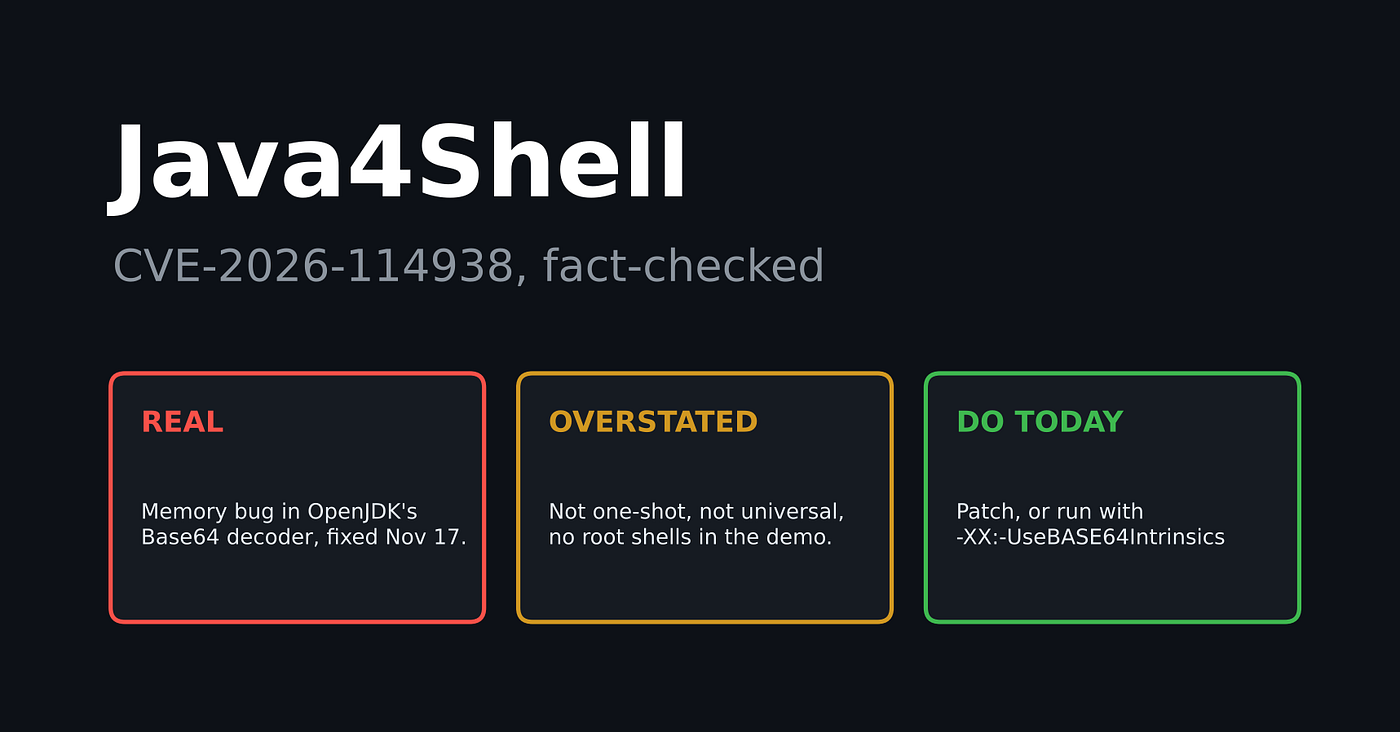
On November 17, 2026, Oracle and the OpenJDK project disclosed CVE-2026-114938, a serious memory-corruption vulnerability in Java’s hardware-accelerated Base64 decoder. Security researchers at Calif named it Java4Shell.
The vulnerability introduces a potentially dangerous combination: malformed Base64 input, an optimized JVM execution path, and memory corruption that can ultimately lead to remote code execution (RCE).
Its implications extend beyond Java developers. Security engineers, DevOps teams, QA architects, platform owners, and organizations operating Java-based enterprise services all have a role to play.
Java4Shell is not another Log4Shell. However, it is an important reminder that the security boundary of an application extends all the way down to its runtime.
1. What Is Java4Shell?
Java4Shell is a vulnerability in the HotSpot JVM’s optimized implementation of Base64 decoding, exposed through the standard Java API:
java.util.Base64.Decoder
The issue affects a hardware-accelerated decoding path that uses AVX-512 VBMI instructions on supported x86-64 processors.
Under specific conditions, specially crafted Base64 input can trigger an out-of-bounds heap write. This means the JVM writes data beyond the memory allocated for the decoded output.
Depending on the application, runtime, processor, and exploit conditions, the consequences can include:
- JVM crashes and denial of service.
- Exposure of sensitive information stored in heap memory.
- Memory corruption.
- Potential arbitrary code execution within the affected Java process.
The vulnerability is tracked as CVE-2026-114938.
The risk is particularly important because Base64 decoding is frequently performed as part of ordinary application workflows, sometimes before authentication is completed.
2. How Does the Vulnerability Work?
Understanding Java4Shell requires looking at the interaction between Java’s standard library and the JVM’s optimized execution mechanisms.
2.1 The Base64 decoding mechanism
Base64 is widely used to represent binary data as text. It is present in authentication headers, tokens, encoded attachments, and API payloads.
Java provides a standard decoder through java.util.Base64.
For performance reasons, HotSpot can replace certain operations with optimized intrinsic implementations. On supported processors, the JVM may use AVX-512 VBMI instructions to accelerate Base64 decoding.
This optimization is transparent to application developers. They continue using the same Java API while the runtime selects a faster implementation.
2.2 The memory-corruption condition
The vulnerability occurs when specially crafted malformed Base64 input reaches the affected accelerated decoder.
Under the vulnerable execution path, the decoder can incorrectly calculate the output boundaries and perform a write outside the allocated buffer.
The critical point is that input validation does not necessarily protect the application: the memory corruption can occur before the decoder rejects the malformed input.
Consequently, an attacker may be able to trigger memory corruption simply by supplying maliciously crafted data to an application that processes attacker-controlled Base64 values.
2.3 From memory corruption to remote code execution
A memory-corruption vulnerability does not automatically mean that an attacker can execute arbitrary code.
The research published by Calif demonstrates how the initial memory corruption can be combined with heap manipulation techniques to construct a more advanced exploitation chain.
The researchers describe techniques involving:
- Heap shaping and memory allocation control.
- Corruption of neighboring array metadata.
- Memory disclosure capabilities, referred to as JavaBleed.
- Controlled memory operations.
- Manipulation of JVM structures to reach code execution.
This distinction matters: triggering the vulnerable decoder and achieving reliable remote code execution are different technical milestones.
Successful exploitation depends on the target environment and requires a more sophisticated, application-specific attack chain.
3. Who Is Actually Affected?
Java4Shell does not affect every Java installation.
Exposure depends on a combination of runtime version, CPU capabilities, and application behavior.
The main affected configurations include:
- OpenJDK-based Java 17.0.6 and later.
- Java 21, Java 25, and Java 27 affected builds.
- x86-64 processors supporting AVX-512 VBMI.
- Applications that process attacker-controlled data through the vulnerable Base64 decoder.
Modern Intel Xeon processors starting with Ice Lake and AMD Zen 4 and newer are among the relevant processor families.
ARM64 systems and x86-64 processors without AVX-512 VBMI are not known to be affected by this specific vulnerability.
Importantly, organizations should not rely solely on java -version or their operating system’s package inventory. Enterprise products frequently bundle their own Java runtime, and container images may include a separate JDK or JRE.
The runtime actually used by each running application must be identified.
4. Why Enterprise Applications Are Particularly Exposed
The biggest concern is not necessarily a custom Java application. It is the number of enterprise products that rely on Java internally.
Identity providers, collaboration platforms, build servers, artifact repositories, and distributed systems routinely process encoded information.
Potentially relevant environments include:
- Keycloak and other identity management solutions.
- Jira and Confluence Data Center.
- Jenkins controllers and build infrastructure.
- JFrog Artifactory.
- Kafka and Elasticsearch-based platforms.
- Java-based API and authentication services.
These examples should not be interpreted as confirmation that every installation is vulnerable. The actual exposure depends on the product version, bundled runtime, CPU architecture, configuration, and vendor-specific remediation status.
One particularly important scenario is authentication.
An application may require valid credentials to access its business features while still decoding authentication headers before validating those credentials.
Therefore, requiring authentication does not automatically eliminate pre-authentication exposure.
For organizations operating Kubernetes-based platforms, the investigation must also cover:
- Java runtimes embedded in container images.
- Application-specific JVM configurations.
- Worker nodes and underlying CPU capabilities.
- Rolling deployments and old replicas.
- Build agents and CI/CD controllers.
- Runtime versions used by sidecars and supporting services.
5. Java4Shell vs. Log4Shell: Understanding the Difference
The name Java4Shell naturally brings back memories of Log4Shell (CVE-2021-44228).
However, the two vulnerabilities are fundamentally different.
| Dimension | Log4Shell | Java4Shell |
|---|---|---|
| CVE | CVE-2021-44228 | CVE-2026-114938 |
| Vulnerable component | Log4j 2 | HotSpot JVM |
| Root cause | Unsafe JNDI lookup behavior | Base64 decoder memory corruption |
| Hardware dependency | No specific CPU requirement | AVX-512 VBMI on x86-64 |
| Exploitation | Malicious lookup strings | Memory corruption and target-specific exploit chains |
| Main remediation | Update affected Log4j versions | Update the affected Java runtime |
Log4Shell demonstrated how a widely used library could expose thousands of organizations to remote attacks.
Java4Shell highlights another layer of the same architectural challenge: even when application code and dependencies are maintained, vulnerabilities in the runtime can introduce serious risks.
The lesson is simple: application security cannot stop at dependency scanning.
6. A Practical DevSecOps Response Plan
Organizations should approach Java4Shell as a runtime security incident requiring coordinated action across development, operations, QA, and security.
Step 1: Build an accurate Java runtime inventory
Identify every Java runtime used across the organization.
Do not limit the investigation to developer workstations or centrally managed JDK installations.
Include:
- Production and pre-production environments.
- Docker and Kubernetes images.
- Third-party enterprise applications.
- Jenkins agents and controllers.
- Internal Java services.
- Embedded and bundled runtimes.
Record the vendor, full runtime version, architecture, CPU capabilities, and application owner.
Step 2: Identify exposed execution environments
Prioritize systems running potentially affected Java builds on x86-64 processors supporting AVX-512 VBMI.
Then identify applications that decode untrusted Base64 input, particularly through authentication headers, tokens, and uploads.
Internet-facing identity providers and DevOps platforms deserve particular attention.
Step 3: Apply vendor-supported security updates
Oracle published fixed Java SE releases as part of its November 17, 2026 security update.
The relevant Oracle fixed versions include:
- Java 17: 17.0.21.1
- Java 21: 21.0.13.1
- Java 25: 25.0.5.1
- Java 27: 27.0.1.1
Other Java distributions have their own release schedules and package identifiers. Always verify the exact fixed build with the runtime vendor and the product vendor.
For applications bundling their own runtime, follow the supported product upgrade path rather than replacing internal Java binaries manually.
Step 4: Apply an interim mitigation where necessary
Where a fixed runtime is not yet available, Red Hat documents the following JVM option as an interim mitigation:
-XX:-UseBASE64Intrinsics
This disables the affected hardware-accelerated Base64 implementation.
It should be tested against application performance and compatibility requirements before deployment. Base64-heavy workloads may experience performance degradation.
This is a temporary mitigation, not a replacement for applying the security update.
Step 5: Validate the remediation
A patch is not complete simply because a deployment pipeline reports success.
After upgrading:
- Restart every affected JVM.
- Rebuild and redeploy container images.
- Confirm the actual runtime version used by each process.
- Verify that old replicas and failover nodes are no longer running vulnerable builds.
- Check application startup and runtime logs.
- Monitor for unexpected crashes and abnormal service restarts.
The remediation must be verified at runtime, not just at build time.
7. The QA Perspective: Security Fixes Must Be Testable
This is where Software Quality Engineering becomes particularly important.
Java4Shell is not simply a vulnerability management problem. It is also a validation challenge.
A rushed Java upgrade can introduce compatibility issues, performance regressions, unexpected behavior, or deployment failures.
QA teams should integrate security remediation into the normal software quality lifecycle.
7.1 Regression testing
Start by identifying the business-critical features that depend on Base64 decoding.
Typical test scenarios include:
- Authentication using Basic authentication headers.
- JWT and token processing.
- SAML authentication workflows.
- File uploads and encoded attachments.
- API requests containing Base64 payloads.
- Invalid and malformed input handling.
Validate both successful and unsuccessful processing paths.
7.2 Negative and robustness testing
Malformed inputs should be part of the security regression suite.
Test cases should cover:
- Invalid Base64 padding.
- Unexpected trailing characters.
- Incorrect encoded lengths.
- Empty and truncated values.
- Large encoded payloads.
- Repeated malformed requests.
- Boundary conditions around decoder input sizes.
The objective is to verify predictable error handling, service stability, and the absence of unexpected crashes.
These tests do not independently prove that the JVM vulnerability is fixed. They complement runtime verification and vendor patch validation.
7.3 Performance testing
Disabling Base64 intrinsics can affect workloads that perform frequent encoding and decoding operations.
Performance testing should therefore compare:
- Baseline performance before remediation.
- Performance after applying the mitigation.
- Performance after installing the permanent fix.
Useful metrics include throughput, response time, CPU consumption, memory usage, and error rates.
Tools such as JMeter, Gatling, and k6 can help validate the impact under representative workloads.
7.4 Security automation in CI/CD
Security validation should become part of the delivery pipeline.
A practical approach combines:
- Software composition analysis.
- Container image scanning.
- Runtime version verification.
- SBOM generation and analysis.
- Security regression testing.
- Deployment policy enforcement.
The pipeline should prevent deployments using known vulnerable runtime builds when an applicable security policy requires patched versions.
8. Turning Java4Shell Into an Opportunity to Improve Runtime Security
Java4Shell exposes a weakness in a common assumption: that maintaining application dependencies is sufficient to maintain application security.
It is not.
A mature DevSecOps strategy must consider the entire software execution chain:
Application → Dependencies → Java Runtime → JVM → Operating System → Infrastructure
Every layer contributes to the overall security posture.
Organizations should move towards continuous runtime inventory, automated vulnerability detection, reproducible container builds, and deployment-time security controls.
More importantly, QA should not be introduced only after a security patch has been deployed. Quality engineering must participate in the remediation strategy from the beginning.
Conclusion: Security Is a Runtime Responsibility
Java4Shell is a reminder that vulnerabilities do not always originate where developers expect them.
A standard Java API, a hardware optimization, and an unexpected memory boundary condition can combine to create a serious enterprise security risk.
The appropriate response is neither panic nor complacency.
Organizations should identify affected environments, prioritize critical services, apply vendor-supported fixes, validate the remediation, and strengthen their runtime security governance.
For QA and DevSecOps professionals, the broader takeaway is clear:
Secure software is not just software that has been tested. It is software whose entire execution environment is continuously identified, monitored, validated, and maintained.