
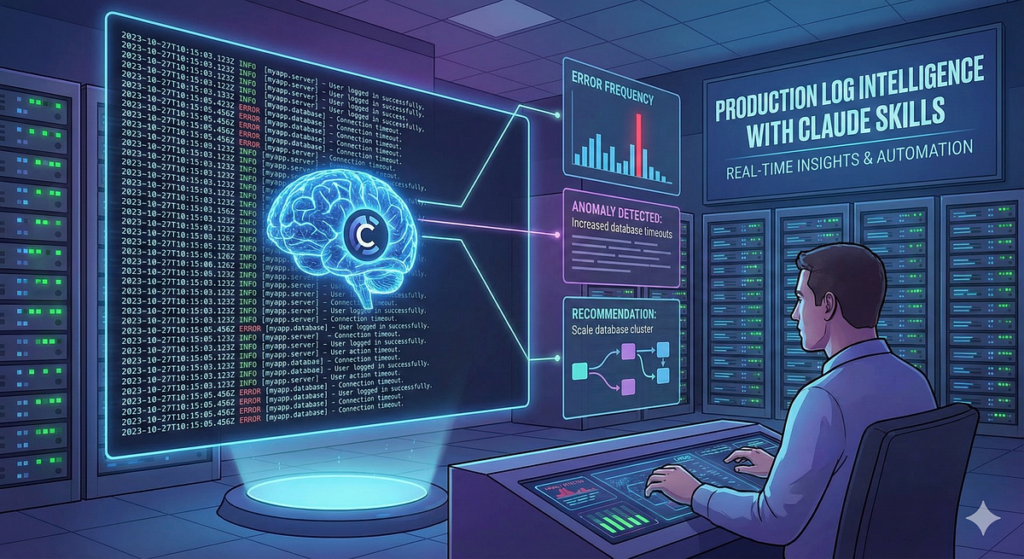
Modern distributed systems generate an extreme volume of logs across Kubernetes clusters, microservices, CI/CD pipelines, API gateways, authentication layers and event-driven architectures.
The challenge today is no longer log collection or observability.
The real problem is interpretation:
- understanding what actually happened
- correlating events across systems
- identifying root cause under time pressure
- reducing incident resolution time
Traditional observability tools provide data visibility.
They do not provide reasoning.
This is where AI models such as Claude Opus and Claude Sonnet introduce a new layer of capability: AI-assisted log reasoning for QAOps and SRE teams.
1. The real problem: logs are abundant, insight is scarce
1.1 Explosion of system logs
In modern enterprise architectures, a single platform may generate:
- millions of log lines per hour
- hundreds of microservices
- multiple environments (dev, QA, staging, production)
- layered infrastructure logs (Kubernetes, networking, storage, security)
- CI/CD execution traces
The result is not a lack of information.
It is an overload of unstructured, distributed signals.
1.2 Fragmented human analysis
During incidents, responsibilities are usually split:
- Dev teams inspect application logs
- DevOps teams inspect infrastructure and Kubernetes logs
- QA teams analyze test executions
- SRE teams monitor system health metrics
Each perspective is partial.
The system-wide narrative is missing.
1.3 Core gap
The missing component in modern observability is not another dashboard.
It is a reasoning layer capable of:
- reconstructing timelines
- correlating cross-service failures
- extracting meaningful signals from noise
- producing structured incident explanations
2. Why Claude models are effective for log analysis
2.1 Log analysis is not search, it is reasoning
Logs are not static data.
They represent:
- sequences of events
- temporal dependencies
- causal chains
- system interactions under stress
Therefore, effective analysis requires:
- sequential reasoning
- context retention
- cross-domain correlation
2.2 Strengths of Claude models in QAOps contexts
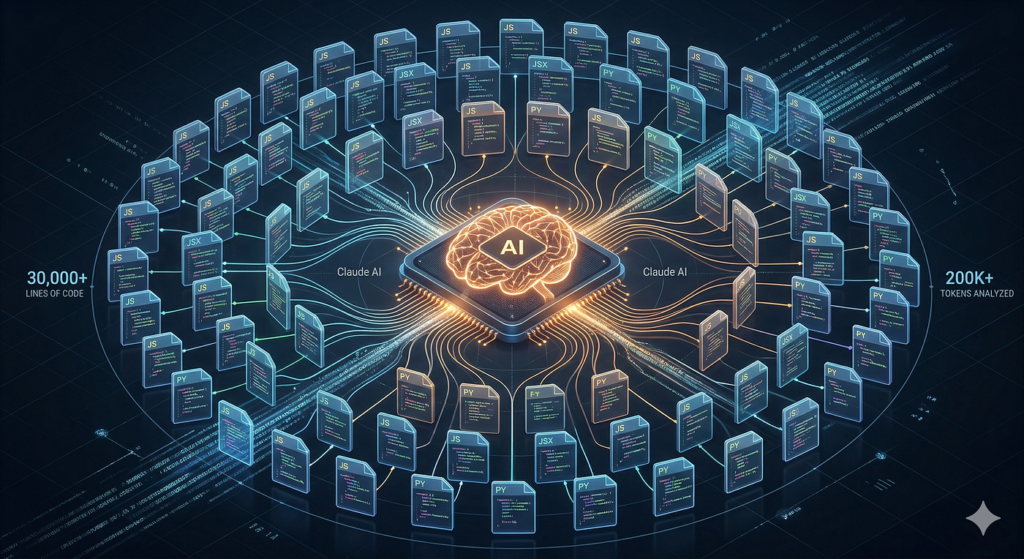
Long context processing
Claude can analyze large volumes of logs, including:
- full incident traces
- multi-service logs
- CI/CD pipeline outputs
- Kubernetes event streams
Narrative reconstruction
Claude can reconstruct a coherent incident story:
- what happened
- in what order
- how failures propagated
- where the system deviated from expected behavior
Cross-system correlation
Claude can connect signals across layers such as:
- application errors
- infrastructure degradation
- deployment changes
- configuration drift
- authentication failures
Structured output generation
Claude can produce structured outputs such as:
- incident summaries
- root cause hypotheses
- impacted services
- severity classification
- recommended actions
3. QAOps architecture with AI log intelligence layer
3.1 Traditional observability model
Logs and metrics flow into tools such as:
- ELK stack
- Datadog
- Grafana
- Prometheus
Engineers then manually interpret dashboards.
3.2 AI-enhanced model
In an AI-augmented architecture:
Logs flow into observability tools, then into an AI reasoning layer powered by Claude models.
This layer produces:
- incident summaries
- root cause analysis drafts
- anomaly explanations
- investigation guidance
This introduces a new abstraction:
AI becomes an investigation assistant between raw telemetry and engineering decision-making.
4. Real-world QAOps use cases
4.1 Root Cause Analysis during production incidents
Typical input:
- Kubernetes events
- application stack traces
- deployment logs
- API errors
- monitoring alerts
Claude can help reconstruct:
- incident timeline
- probable failure origin
- contributing factors
- dependency breakdowns
Example patterns it can identify:
- misconfigured deployment variables
- missing secrets or credentials
- resource exhaustion (CPU/memory)
- cascading service failures
- startup dependency issues
4.2 Kubernetes troubleshooting
Common issues include:
- CrashLoopBackOff
- ImagePullBackOff
- OOMKilled errors
- readiness/liveness probe failures
- RBAC permission issues
AI-assisted analysis can quickly classify:
- configuration errors
- resource constraints
- authentication issues
- dependency failures
- deployment inconsistencies
4.3 CI/CD pipeline debugging
CI/CD systems generate complex logs across:
- Jenkins
- GitHub Actions
- GitLab CI
- test automation frameworks
Claude can assist in:
- identifying flaky tests
- detecting environment drift
- isolating pipeline failures
- distinguishing real regressions from infra issues
- summarizing build failures
4.4 Flaky test detection
One of the highest value QA use cases.
Claude can classify failures into:
- deterministic regression
- flaky test behavior
- environment instability
- data inconsistency
- timing-related issues
This significantly reduces debugging time in large test suites.
4.5 Incident summarization
Instead of manually writing RCA reports, AI can generate:
- structured incident reports
- chronological breakdowns
- affected systems overview
- hypothesis-based root cause analysis
Engineers then validate and refine.
5. Prompt patterns for effective log analysis
5.1 Root cause analysis prompt
Analyze the following logs and provide:
- incident timeline
- most likely root cause
- contributing factors
- impacted systems
- recommended next debugging steps
5.2 Kubernetes debugging prompt
Act as a senior SRE and analyze these Kubernetes logs.
Identify:
- why the pods are failing
- whether the issue is configuration, resource, or dependency related
- severity level
- immediate remediation steps
5.3 CI/CD failure analysis prompt
Analyze this pipeline failure and classify it as:
- test failure
- infrastructure issue
- code regression
- environment drift
Provide reasoning and fix suggestions.
5.4 Flaky test detection prompt
Analyze repeated test failures across builds.
Determine whether the issue is:
- flaky test
- real regression
- environment instability
Explain the reasoning.
6. Limitations and risks
AI-assisted log analysis has constraints:
- possible incorrect causal inference
- missing context leads to incomplete conclusions
- over-generalization of patterns
- no direct access to runtime systems
Therefore, outputs must always be validated by engineering teams.
AI is an assistant, not an authority.
7. Shift toward AI observability intelligence
The observability stack is evolving:
From:
- logs
- metrics
- dashboards
To:
- telemetry + AI reasoning
- automated incident interpretation
- contextual anomaly detection
- AI-assisted debugging workflows
This represents a transition from visibility to understanding.
8. Impact on QA and engineering roles
The role of QA is evolving toward:
- QAOps engineering
- observability intelligence
- release risk analysis
- AI-assisted debugging
- quality governance systems
Engineering teams will increasingly rely on AI for:
- investigation acceleration
- incident summarization
- failure classification
- decision support
The future of log analysis is not better dashboards.
It is better interpretation.
Claude-like models do not replace engineering expertise.
They remove the cognitive overhead between raw system data and actionable understanding.
The result is faster investigation, better decisions, and improved system reliability.