
How autonomous AI agents are redefining software delivery from code commit to production.
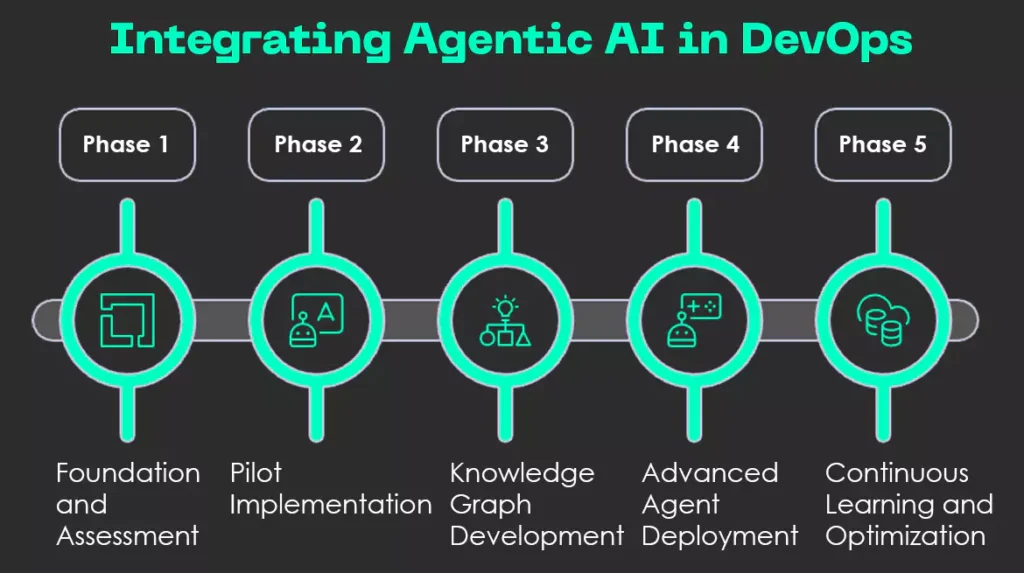
For more than two decades, DevSecOps has fundamentally transformed how organizations build, test, deploy, and operate software. Continuous Integration (CI), Continuous Delivery (CD), Infrastructure as Code (IaC), Kubernetes, GitOps, Platform Engineering, and Site Reliability Engineering (SRE) have collectively accelerated software delivery while improving reliability and scalability.
Yet, despite these advances, modern DevSecOps teams face an unprecedented level of complexity.
A single production deployment may involve hundreds of microservices, thousands of automated tests, multiple cloud providers, dozens of security controls, infrastructure policies, compliance requirements, feature flags, observability platforms, and approval workflows. While pipelines have become highly automated, they remain largely deterministic—they execute predefined scripts but cannot understand context, adapt to changing conditions, or make informed decisions.
This is where Agentic AI represents the next major evolution.
Instead of merely automating predefined tasks, Agentic AI introduces autonomous software agents capable of reasoning, planning, collaborating, learning, and taking actions toward achieving engineering objectives under clearly defined governance.
The future of DevSecOps is no longer about building smarter pipelines.
It is about building intelligent software delivery ecosystems.
The Evolution of DevSecOps
Every generation of DevSecOps has addressed a different challenge.
| Era | Primary Goal |
|---|---|
| Manual Operations | Reduce operational errors |
| Continuous Integration | Automate software builds |
| Continuous Delivery | Accelerate releases |
| Infrastructure as Code | Standardize infrastructure |
| Kubernetes | Simplify container orchestration |
| GitOps | Infrastructure through Git |
| Platform Engineering | Improve developer experience |
| Agentic DevSecOps | Enable autonomous decision-making |
Each stage reduced manual effort.
Agentic AI goes further by reducing manual decision-making.
Rather than asking engineers to constantly interpret logs, investigate failed pipelines, prioritize alerts, or manually coordinate deployments, AI agents can perform these activities autonomously while keeping humans responsible for governance and strategic decisions.
Why Traditional CI/CD Pipelines Are Reaching Their Limits
Today’s CI/CD pipelines are remarkably efficient, but they still operate according to fixed rules.
They execute predefined workflows without understanding why failures occur or how to resolve them.
Consider a typical deployment failure.
A pipeline detects a failing integration test.
The pipeline stops.
An engineer investigates logs.
The engineer identifies the issue.
The engineer creates a fix.
The pipeline runs again.
Although automated, the investigation process remains largely manual.
Now imagine an Agentic pipeline.
The Testing Agent identifies the failing tests.
The Log Analysis Agent correlates application logs, Kubernetes events, and infrastructure metrics.
The Root Cause Analysis Agent determines that the failure originates from a recently modified API contract.
The Planning Agent recommends reverting the affected component while notifying the development team.
The Deployment Agent pauses production rollout until approval is received.
Instead of simply reporting failures, the system actively collaborates to solve them.
What Is Agentic AI?
Agentic AI refers to AI systems capable of pursuing goals through reasoning, planning, memory, tool usage, and collaboration with other agents.
Unlike traditional AI assistants that respond to user prompts, AI agents continuously observe their environment, evaluate objectives, execute actions, and adapt their behavior based on feedback.
An Agentic DevSecOps platform therefore consists of multiple specialized agents rather than a single general-purpose assistant.
Each agent owns a specific responsibility while collaborating with other agents to achieve shared delivery objectives.
Examples include:
- Planning Agent
- Code Review Agent
- Security Agent
- Testing Agent
- Deployment Agent
- Observability Agent
- Incident Response Agent
- Cost Optimization Agent
- Knowledge Management Agent
Together they create an intelligent software delivery platform capable of supporting engineering teams throughout the entire software lifecycle.
AI Assistant vs Automation vs AI Agent
Although these concepts are often confused, they solve different problems.
| Capability | Automation | AI Assistant | AI Agent |
|---|---|---|---|
| Executes predefined tasks | ✅ | Limited | ✅ |
| Understands context | ❌ | Partial | ✅ |
| Uses reasoning | ❌ | Limited | ✅ |
| Plans multiple steps | ❌ | Limited | ✅ |
| Learns from previous outcomes | ❌ | Limited | ✅ |
| Collaborates with other agents | ❌ | ❌ | ✅ |
| Uses external tools autonomously | ❌ | Partial | ✅ |
Traditional automation focuses on execution.
AI assistants focus on interaction.
Agentic AI focuses on achieving objectives.
This distinction fundamentally changes how DevSecOps systems operate.
The Anatomy of an Agentic DevSecOps Platform
A modern Agentic DevSecOps platform resembles a collaborative engineering organization.
Developer

      │

Planning Agent

      │

Code Review Agent

      │

Security Agent

      │

Build Agent

      │

Testing Agent

      │

Deployment Agent

      │

Observability Agent

      │

Optimization Agent

      │

Production
Every agent contributes specialized expertise while sharing information through a common orchestration layer.
Rather than functioning independently, they continuously exchange context, enabling coordinated decision-making across the software delivery lifecycle.
Seven AI Agents Every DevSecOps Team Should Understand
Planning Agent
Analyzes incoming work, estimates impact, identifies dependencies, and recommends execution strategies before development begins.
Code Review Agent
Evaluates pull requests for maintainability, coding standards, architectural consistency, and potential defects.
Unlike static analyzers, it explains why improvements are recommended.
Security Agent
Continuously performs vulnerability detection, dependency analysis, secret scanning, Infrastructure as Code validation, container image inspection, and compliance verification.
Security becomes integrated into every stage of delivery instead of acting as a final checkpoint.
Testing Agent
Determines which tests should execute based on code changes.
It may recommend new automated tests, detect flaky scenarios, prioritize regression suites, and summarize failures for developers.
Deployment Agent
Selects appropriate deployment strategies such as Blue-Green, Canary, or Rolling Updates based on organizational policies and production risk.
Observability Agent
Correlates metrics, logs, traces, Kubernetes events, and application telemetry to identify anomalies before they impact users.
Optimization Agent
Continuously analyzes deployment frequency, build duration, infrastructure utilization, cloud costs, and engineering productivity to recommend improvements.
Human-in-the-Loop Governance
Autonomous does not mean uncontrolled.
Enterprise adoption requires governance.
Organizations should clearly define:
- Which actions agents may execute automatically.
- Which actions require human approval.
- Which environments permit autonomous changes.
- How decisions are audited.
- How permissions are managed.
- How AI recommendations are validated.
Critical production deployments, security exceptions, and compliance decisions should remain under human oversight.
Agentic AI augments engineering judgment—it does not replace accountability.
Benefits of Agentic DevSecOps
Organizations adopting Agentic DevSecOps may expect improvements in several areas:
- Faster software delivery.
- Reduced mean time to resolution (MTTR).
- Earlier detection of deployment risks.
- Smarter test execution.
- Improved developer productivity.
- Enhanced platform reliability.
- Better utilization of engineering knowledge.
- Continuous optimization of delivery pipelines.
Most importantly, engineers spend less time reacting to operational issues and more time designing resilient systems.
Challenges to Overcome
Despite its potential, Agentic DevSecOps introduces new responsibilities.
Key challenges include:
- AI governance.
- Trust and explainability.
- Secure tool access.
- Identity and permissions.
- Regulatory compliance.
- Cost management.
- Observability of AI decisions.
- Preventing cascading autonomous failures.
Successful adoption depends on balancing autonomy with governance.
Looking Ahead
Agentic AI should not be viewed as a replacement for DevSecOps engineers.
Instead, it represents the evolution of the DevSecOps role itself.
Tomorrow’s engineers will spend less time writing deployment scripts and more time designing intelligent delivery systems, defining governance policies, supervising AI agents, and continuously improving software platforms.
The future DevSecOps engineer will become an orchestrator of intelligent systems rather than an operator of automated pipelines.
Organizations that begin preparing today will be better positioned to build resilient, adaptive, and scalable software delivery platforms capable of meeting the demands of the next decade.
DevSecOps has always been about accelerating software delivery through collaboration and automation.
Agentic AI extends this philosophy by introducing intelligent agents that can reason, collaborate, and adapt throughout the software delivery lifecycle.
Rather than replacing existing DevSecOps practices, Agentic AI builds upon CI/CD, GitOps, Platform Engineering, Kubernetes, and Infrastructure as Code to create a more autonomous and context-aware engineering ecosystem.
The next generation of software delivery will not be defined solely by faster pipelines.
It will be defined by intelligent systems capable of helping engineering teams make better decisions, respond more quickly to change, and continuously improve how software is built, tested, secured, deployed, and operated.