

For years, DevOps promised faster delivery and better collaboration between development and operations. Pipelines were automated, infrastructure became code, and deployments accelerated.
Yet, as organizations scaled, a new problem appeared: complexity.
Developers now face Kubernetes manifests, Terraform modules, CI templates, security policies, observability stacks, and cloud configurations before they can even ship a feature. Productivity suffers, onboarding becomes painful, and standards are hard to enforce.
This is where Platform Engineering emerges.
Instead of asking every team to master infrastructure and tooling, companies build Internal Developer Platforms (IDPs) powered by giant cloud-native tools. These platforms provide golden paths, self-service, and consistency while hiding operational complexity.
Platform Engineering is not about running tools. It’s about engineering a product for developers.
Why DevOps Is No Longer Enough
DevOps focused on collaboration and automation, but it left a gap: ownership of the developer experience.
In many organizations today:
- Each team builds its own pipelines.
- Infrastructure is copied and modified everywhere.
- Kubernetes usage becomes fragmented.
- Security rules differ across services.
- Observability is inconsistent.
DevOps gave speed, but not standardization at scale.
Platform Engineering fills this gap by creating a centralized, product-driven platform that developers consume instead of re-implementing.
The shift is simple:
👉 from pipelines per team → to platforms for the organization.
What Is Platform Engineering?
Platform Engineering is the discipline of designing and building reusable platforms that enable developers to ship software faster, safer, and with less cognitive load.
A platform team acts like a product team:
- Developers are the customers.
- The platform is the product.
- APIs and workflows are the interfaces.
Instead of giving raw tools, the platform offers:
- Standardized deployment paths.
- Self-service infrastructure.
- Security by default.
- Observability out of the box.
This allows application teams to focus on business logic instead of infrastructure complexity.
Internal Developer Platforms (IDP) Explained
An Internal Developer Platform is a curated ecosystem that abstracts infrastructure, CI/CD, security, and observability behind simple workflows.
A typical IDP provides:
- Project scaffolding.
- Environment provisioning.
- Deployment automation.
- Secrets management.
- Monitoring integration.
- Documentation and discovery.
Rather than asking developers to write Terraform, Helm, and YAML from scratch, the platform exposes golden paths that are safe and scalable.
The goal is not control — it is enablement with guardrails.
Kubernetes as the Universal Runtime
At the heart of most platforms lies Kubernetes.
It is no longer just a container orchestrator; it is the control plane for modern software platforms.
Kubernetes enables:
- Declarative infrastructure.
- Horizontal scalability.
- Environment isolation.
- Policy enforcement.
- Workload standardization.
Platform teams use Kubernetes as a foundation to expose higher-level abstractions:
- Application templates.
- Deployment strategies.
- Networking models.
- Security boundaries.
Instead of every team managing clusters manually, the platform defines a consistent runtime across the organization.
Infrastructure with Terraform and Crossplane
Infrastructure is a critical part of platforms.
With Terraform, platform teams codify cloud resources:
- Networks.
- Databases.
- Storage.
- IAM policies.
Terraform standardizes provisioning across AWS, Azure, and GCP.
Crossplane goes further by extending Kubernetes itself to manage infrastructure. It allows teams to define cloud resources as Kubernetes objects.
This unifies:
- App deployment.
- Infrastructure provisioning.
- Lifecycle management.
Platforms evolve from scripting infrastructure to composing infrastructure as APIs.
GitOps with ArgoCD
Platform Engineering embraces GitOps as a core principle.
With tools like ArgoCD, Git becomes the single source of truth for:
- Environments.
- Applications.
- Configurations.
ArgoCD continuously reconciles desired state with runtime state in Kubernetes.
This brings:
- Auditability.
- Rollbacks.
- Declarative deployments.
- Consistency across environments.
Instead of running imperative commands, teams describe systems, and the platform ensures convergence.
Standardization with Helm
Without packaging, platforms become chaotic.
Helm acts as the package manager of Kubernetes:
- Templates Kubernetes manifests.
- Encapsulates best practices.
- Enforces defaults and policies.
Platform teams create golden Helm charts for services, jobs, and infrastructure components.
Developers consume them without worrying about low-level configuration.
Standardization becomes a feature, not a constraint.
Developer Portals with Backstage
A platform is useless if developers cannot discover it.
Backstage, created by Spotify, is a key component of modern IDPs.
It provides:
- Service catalog.
- Documentation hub.
- Template system.
- Ownership tracking.
- Plugin ecosystem.
Backstage becomes the front door of the platform, unifying tools, documentation, and workflows.
Instead of searching across wikis and repos, developers access everything from one place.
Self-Service Environments
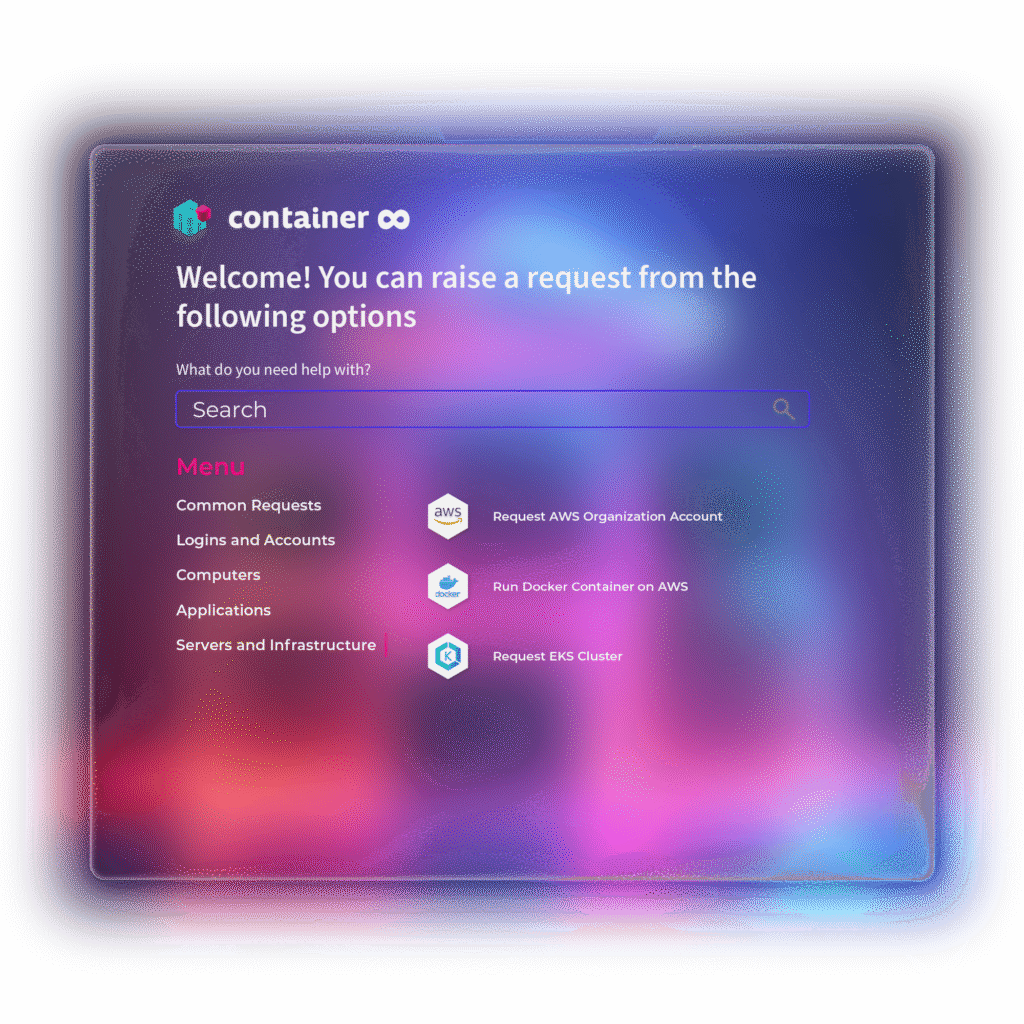
One of the biggest wins of Platform Engineering is self-service.
Platforms allow developers to:
- Create projects.
- Provision environments.
- Deploy services.
- Access logs and metrics.
All without opening tickets.
Self-service removes friction and increases autonomy while still respecting organizational standards.
Observability with OpenTelemetry and Grafana
A platform must provide visibility.
With OpenTelemetry, teams collect:
- Logs.
- Metrics.
- Traces.
These signals are visualized in tools like Grafana and integrated into alerting systems.
Instead of adding observability per project, the platform embeds it by default.
This transforms troubleshooting from chaos into structured analysis.
Security and Governance by Design
Security cannot be optional in platforms.
Platform teams integrate:
- Secret management.
- Policy as code.
- Image scanning.
- Network isolation.
Security becomes invisible but enforced.
Developers ship faster without sacrificing compliance.
Common Anti-Patterns
Platform Engineering fails when:
- Platforms become rigid.
- Teams bypass standards.
- The platform ignores developer feedback.
- Too much abstraction hides reality.
A platform is successful only when it is treated as a product with continuous iteration.
The Platform Team Mindset
Platform teams are not operations teams.
They are:
- Product designers.
- API engineers.
- Enablement specialists.
Their success metric is not uptime only — it is developer productivity and satisfaction.
Platform Engineering is reshaping how organizations build software.
With giant tools like Kubernetes, Terraform, ArgoCD, Helm, and Backstage, teams move from scattered DevOps pipelines to cohesive Internal Developer Platforms.
The future is not about shipping faster scripts.
It is about shipping better platforms for developers.