
How GDPR, ISO/IEC 27001, ISO/IEC 42001, WCAG 2.2, RGAA, the EU AI Act, and the NIST AI Risk Management Framework Are Shaping the Next Generation of Software Quality
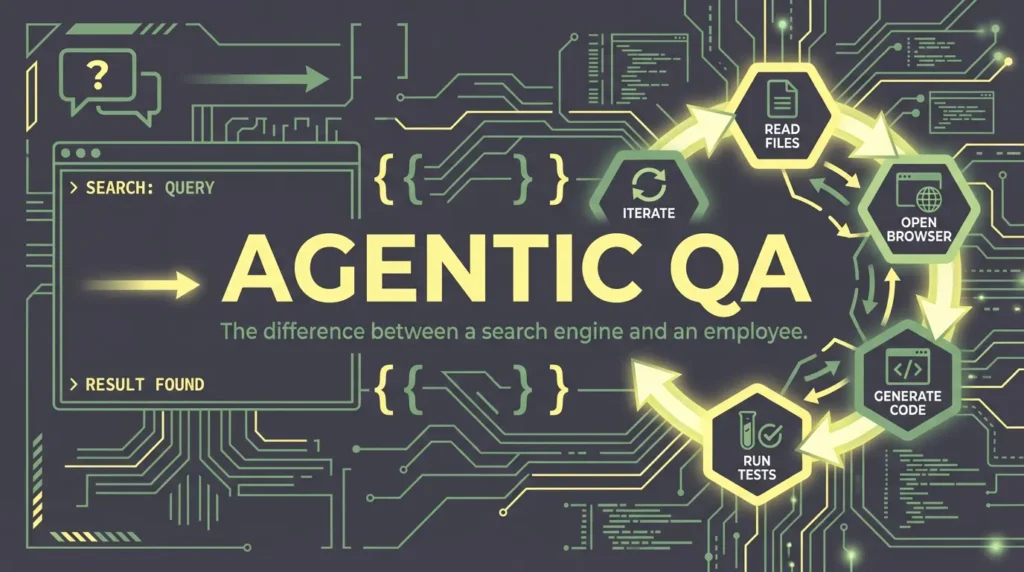
Software Quality Engineering is entering a new era driven by autonomous Artificial Intelligence. For decades, organizations have invested in test automation frameworks, Continuous Integration (CI), Continuous Delivery (CD), DevOps, and DevSecOps to improve software quality while accelerating delivery. These practices significantly increased productivity but remained largely deterministic, relying on predefined rules, manually designed test suites, and static execution strategies.
Today, the emergence of Agentic AI fundamentally changes this landscape.
Unlike conventional automation, Agentic QA systems can reason, plan, adapt, collaborate with enterprise systems, and continuously improve their recommendations based on contextual information. They are capable of analyzing user stories, identifying quality risks, generating automated tests, validating regulatory controls, prioritizing regression campaigns, investigating production incidents, and supporting release decisions with minimal human intervention.
However, increasing autonomy also increases responsibility.
Enterprise AI systems must be designed according to internationally recognized governance principles that ensure security, privacy, accessibility, transparency, explainability, and accountability. Organizations cannot simply deploy autonomous AI agents into software delivery pipelines without establishing appropriate technical, organizational, and regulatory safeguards.
Frameworks such as the General Data Protection Regulation (GDPR), ISO/IEC 27001, ISO/IEC 42001, WCAG 2.2, RGAA, the NIST AI Risk Management Framework (AI RMF), OWASP, and the European Union AI Act provide a comprehensive foundation for building trustworthy AI-powered Quality Engineering platforms.
Rather than considering compliance as an external obligation, forward-looking organizations are increasingly adopting a Compliance by Design philosophy where regulatory controls are embedded directly into engineering workflows, CI/CD pipelines, and AI decision-making processes.
This article explores how Agentic QA is transforming enterprise software quality while demonstrating how global governance frameworks can be integrated into modern DevSecOps and GitOps practices.
The Evolution of Software Quality Engineering
Software quality has continuously evolved alongside software engineering itself.
Each technological transformation has required new quality practices capable of addressing increasing architectural complexity.
| Generation | Primary Objective | Representative Technologies | Main Limitation |
|---|---|---|---|
| Manual Testing | Functional validation | Test plans, spreadsheets | Limited scalability |
| Automated Testing | Regression automation | Selenium, Robot Framework, UFT | High maintenance costs |
| Continuous Testing | Pipeline integration | Jenkins, GitLab CI, Azure DevOps | Static execution logic |
| AI-Assisted QA | Productivity enhancement | GitHub Copilot, ChatGPT | Reactive interaction |
| Agentic QA | Autonomous decision-making | Multi-agent AI platforms | Governance complexity |
Each generation solved important challenges while exposing new opportunities.
Manual testing could not sustain modern release frequencies.
Automation reduced repetitive work but remained dependent on manually maintained scripts.
Continuous Integration accelerated deployments while leaving testing strategies largely unchanged.
Generative AI introduced intelligent assistance but still required explicit prompts from human users.
Agentic QA extends this progression by introducing autonomous reasoning and adaptive execution.
Understanding Agentic QA
Agentic QA represents the convergence of Artificial Intelligence, Quality Engineering, DevSecOps, cloud-native architectures, and enterprise governance.
Instead of executing predefined scripts, AI agents pursue business objectives.
For example, rather than executing every regression scenario after each deployment, an autonomous quality platform can:
- Analyze source code changes
- Evaluate impacted business capabilities
- Inspect historical production incidents
- Prioritize high-risk user journeys
- Generate missing test scenarios
- Execute targeted regression campaigns
- Recommend deployment decisions
- Document quality evidence automatically
The emphasis shifts from test execution toward quality intelligence.
Core Capabilities of Agentic QA
An enterprise-grade Agentic QA platform combines several complementary capabilities.
| Capability | Description | Business Value |
|---|---|---|
| Goal-Oriented Planning | Break complex objectives into executable tasks | Increased productivity |
| Context Awareness | Understand requirements, code, architecture, and production signals | Better decision quality |
| Autonomous Orchestration | Coordinate multiple testing activities | Reduced manual effort |
| Continuous Learning | Improve recommendations through operational feedback | Increased accuracy |
| Explainability | Justify every recommendation | Regulatory readiness |
| Human Collaboration | Escalate high-risk decisions | Responsible AI governance |
These capabilities distinguish Agentic QA from conventional automation frameworks.
Why Modern Enterprises Need Agentic QA
Software systems have become dramatically more complex.
A typical enterprise application may include:
- Microservices
- REST and GraphQL APIs
- Kubernetes clusters
- Serverless functions
- Event-driven architectures
- Service meshes
- Cloud-native databases
- Third-party SaaS integrations
- Identity providers
- Observability platforms
Each deployment may impact dozens of interconnected services.
Traditional regression strategies struggle to adapt efficiently to this complexity.
Agentic QA enables organizations to prioritize quality activities according to technical and business risk rather than executing identical validation strategies after every deployment.
Quality Engineering Across the Software Development Life Cycle
Modern Quality Engineering extends far beyond software testing.
Agentic QA accompanies software throughout the entire Software Development Life Cycle (SDLC).
| SDLC Phase | Agentic QA Responsibilities |
|---|---|
| Requirements | Detect ambiguities and missing acceptance criteria |
| Architecture | Identify quality and compliance risks |
| Development | Generate unit, API, integration, and UI test cases |
| Continuous Integration | Prioritize regression execution |
| Continuous Delivery | Evaluate deployment readiness |
| Production | Analyze telemetry and recommend improvements |
Quality therefore becomes a continuous engineering discipline rather than a final verification activity.
Agentic QA and DevSecOps
DevSecOps integrates software development, security, and operations into a unified delivery model.
Agentic QA naturally extends this philosophy.
Instead of treating quality as an isolated validation step, autonomous agents continuously collaborate with existing DevSecOps practices.
Typical responsibilities include:
- Analyzing pull requests
- Validating coding standards
- Generating automated tests
- Executing security validation
- Verifying accessibility requirements
- Monitoring production behavior
- Supporting release governance
Quality becomes embedded within every engineering activity.
GitOps and Intelligent Release Validation
GitOps has become the preferred deployment model for Kubernetes-based environments because infrastructure and application configurations are managed through version-controlled repositories.
Agentic QA enhances GitOps by validating changes before synchronization occurs.
Typical validation activities include:
- Infrastructure consistency verification
- Deployment impact analysis
- Configuration validation
- Security policy evaluation
- Accessibility verification
- Compliance assessment
- Release readiness scoring
Instead of relying solely on predefined pipeline rules, AI agents continuously evaluate deployment risks using contextual information.
From Quality by Design to Compliance by Design
Historically, compliance activities often occurred immediately before production releases.
This approach introduces delays, increases remediation costs, and creates unnecessary operational risk.
Modern engineering organizations increasingly adopt Compliance by Design.
Under this model, regulatory requirements are integrated directly into software delivery pipelines.
Every pull request, build, deployment, and production event contributes to the organization’s overall compliance posture.
Rather than asking:
“Is the application compliant before release?”
engineering teams continuously ask:
“Does every software change remain compliant throughout its lifecycle?”
This subtle shift transforms compliance from an auditing exercise into an engineering capability.
Why Governance Matters
Agentic QA platforms may access source code repositories, deployment pipelines, enterprise documentation, production telemetry, monitoring platforms, and customer-related information.
Without appropriate governance, these capabilities introduce significant risks.
Examples include:
| Risk | Potential Impact |
|---|---|
| Unauthorized repository access | Intellectual property exposure |
| Excessive permissions | Infrastructure compromise |
| AI hallucinations | Incorrect quality recommendations |
| Sensitive data exposure | GDPR violations |
| Missing explainability | Audit failures |
| Uncontrolled AI autonomy | Operational instability |
Governance ensures that intelligent systems remain predictable, accountable, and trustworthy.
Enterprise Benefits
Organizations successfully implementing Agentic QA typically observe improvements across multiple dimensions.
| Business Objective | Expected Outcome |
|---|---|
| Faster Releases | Reduced regression execution time |
| Higher Quality | Earlier defect detection |
| Improved Security | Continuous policy validation |
| Better Compliance | Automated regulatory controls |
| Lower Operational Risk | Intelligent deployment recommendations |
| Enhanced Collaboration | Shared AI-assisted decision-making |
Agentic QA therefore delivers value far beyond traditional test automation.
Agentic QA represents the next evolution of Software Quality Engineering.
By combining autonomous reasoning, enterprise governance, continuous learning, and intelligent orchestration, organizations can transform software quality from a reactive validation activity into a proactive engineering discipline.
However, intelligent automation must be accompanied by equally intelligent governance.
The next part explores how international standards—including GDPR, ISO/IEC 27001, and ISO/IEC 42001—provide the governance framework required to build secure, explainable, accessible, and trustworthy AI-powered Quality Engineering platforms.