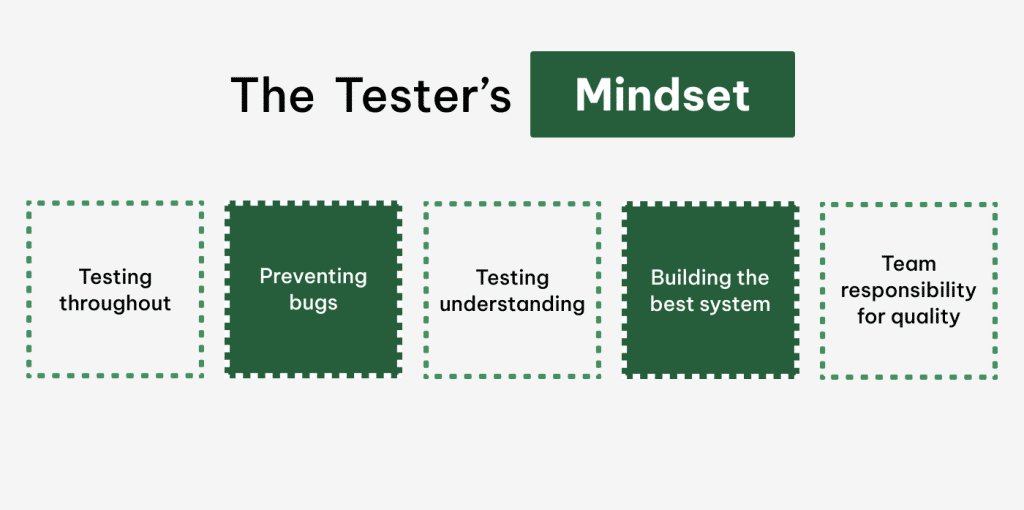

Why Most Testing Efforts Fail Despite Structure
In many organizations, testing appears mature on the surface. There are detailed test cases, organized test suites, automation pipelines, and reporting dashboards. Metrics are tracked, coverage is monitored, and execution cycles are planned.
Yet, despite all this apparent rigor, defects still escape into production. Critical issues are discovered by end users. Systems behave unpredictably under real-world conditions.
This paradox reveals a fundamental truth: testing maturity cannot be measured solely by processes, tools, or volume of execution.
At its core, testing is not a procedural activity. It is an intellectual discipline. It is driven by reasoning, questioning, and the ability to anticipate failure.
The true differentiator between average and high-impact testers is not the number of executed test cases, but the depth and quality of their thinking.
1. The Misconception of Testing as Execution
A common assumption in software teams is that increasing the number of test cases or automated scripts leads to better quality. This belief encourages teams to prioritize volume over insight.
However, execution without reflection leads to a dangerous illusion of coverage.
Running hundreds of test cases that validate expected behavior does not guarantee that the system is resilient. It simply confirms that predefined scenarios behave as anticipated.
What remains untested are:
- unexpected user behaviors,
- edge conditions,
- integration failures,
- timing-related issues,
- and system interactions under stress.
Testing, therefore, must evolve from execution to analytical exploration.
A tester’s responsibility is not limited to confirming that the system works as specified. It extends to identifying where specifications fall short and where the system might fail in unpredictable ways.
2. Testing as an Investigative Discipline
High-performing testers approach systems with an investigative mindset. They operate similarly to analysts or investigators who seek to understand not only what works, but what could go wrong under varying conditions.
They question assumptions embedded in requirements, challenge design decisions, and explore beyond documented scenarios.
Instead of asking whether a feature behaves correctly, they examine:
- how it behaves under abnormal conditions,
- how it reacts to invalid or unexpected inputs,
- how it interacts with other components,
- and how it degrades under failure.
For example, in a payment system, validating successful and failed transactions is only a starting point. A deeper investigation includes scenarios such as:
- network latency during transaction processing,
- duplicate submission due to user actions,
- inconsistent states between frontend and backend,
- partial failures across distributed services.
This approach transforms testing from validation into systematic risk discovery.
3. The Structural Limitations of Test Cases
Test cases provide structure, traceability, and repeatability. They are essential for ensuring baseline coverage and regression stability.
However, they also introduce a constraint: they define the boundaries of what is explicitly tested.
When testers rely exclusively on predefined test cases, they risk overlooking behaviors that were not anticipated during test design.
No matter how comprehensive a test suite appears, it cannot fully represent the complexity of real-world usage. Systems operate in dynamic environments where variables constantly change, and user interactions are not always predictable.
Therefore, test cases should be viewed as guidelines rather than exhaustive representations of system behavior.
Experienced testers use them as a foundation while continuously extending their scope through critical thinking and exploration.
4. Exploratory Testing as a Core Competency
Exploratory testing is often misunderstood as unstructured or informal testing. In reality, it is a disciplined approach that integrates learning, test design, and execution simultaneously.
It requires testers to actively engage with the system, observe its behavior, and adapt their testing strategy based on findings.
Through exploratory testing, testers uncover:
- hidden defects that are not covered by scripted scenarios,
- usability issues that impact user experience,
- inconsistencies across system components,
- and unexpected behaviors resulting from complex interactions.
This approach is particularly effective in identifying defects that emerge from combinations of conditions rather than isolated inputs.
Exploratory testing also strengthens a tester’s understanding of the system, enabling more informed decision-making in both manual and automated testing strategies.
5. The Risk of “Happy Path” Bias
One of the most common weaknesses in testing strategies is the overemphasis on “happy path” scenarios. These are ideal flows where the system behaves exactly as intended under normal conditions.
While necessary, these scenarios represent only a fraction of real-world usage.
In production environments, systems are exposed to:
- invalid inputs,
- concurrent operations,
- network instability,
- hardware limitations,
- and unpredictable user behavior.
Focusing primarily on ideal conditions creates a false sense of reliability.
Robust testing requires intentionally deviating from expected flows. Testers must simulate adverse conditions, interrupt processes, and introduce variability to observe how the system responds.
This approach reveals vulnerabilities that would otherwise remain undetected until they impact end users.
6. Curiosity and Critical Thinking as Foundational Skills
Technical skills alone are insufficient to ensure effective testing. The most impactful testers are distinguished by their intellectual traits, particularly curiosity and critical thinking.
Curiosity drives testers to explore beyond requirements and question assumptions. It encourages continuous learning and deeper system understanding.
Critical thinking enables testers to:
- analyze system behavior,
- identify inconsistencies,
- evaluate risks,
- and prioritize testing efforts effectively.
Without these attributes, testing becomes a mechanical activity that lacks depth and fails to uncover significant issues.
Cultivating these skills requires deliberate practice, reflection, and exposure to diverse testing scenarios.
7. Collaboration as a Catalyst for Quality
Testing cannot be isolated from the rest of the development process. Quality emerges from collaboration between testers, developers, product owners, and other stakeholders.
By engaging early in the development lifecycle, testers can:
- influence requirement clarity,
- identify potential risks before implementation,
- and contribute to more testable designs.
Effective collaboration also fosters shared ownership of quality. Instead of positioning testing as a gatekeeping function, teams align around a common objective: delivering reliable and robust software.
This shift reduces defects, accelerates feedback loops, and enhances overall team performance.
8. The Role and Limitations of Automation
Automation plays a critical role in modern testing strategies. It enables scalability, repeatability, and rapid feedback.
However, automation is inherently limited by the scenarios it encodes. It cannot independently identify unknown risks or adapt to unexpected conditions.
When used without a strong testing mindset, automation can reinforce existing blind spots by repeatedly validating the same assumptions.
Effective automation strategies focus on:
- critical business flows,
- high-risk areas,
- and stable functionalities.
At the same time, they are complemented by exploratory testing and continuous analysis.
Automation should be viewed as a tool that amplifies human thinking, not as a replacement for it.
9. Testing as Risk Management
Ultimately, testing is an exercise in risk management. The goal is not to prove that a system is defect-free, but to identify and mitigate risks that could impact users or business operations.
This requires prioritization based on:
- business criticality,
- likelihood of failure,
- and potential impact.
By focusing on high-risk areas, testers maximize their contribution to product quality and reliability.
Redefining the Value of a Tester
The value of a tester cannot be measured by the number of executed tests or detected defects alone.
It is defined by their ability to:
- anticipate failures,
- challenge assumptions,
- and uncover risks before they materialize.
Testing, when approached with the right mindset, becomes a strategic function that directly influences product success.
A tester who executes without thinking adds limited value. A tester who thinks critically becomes a key contributor to quality and innovation.